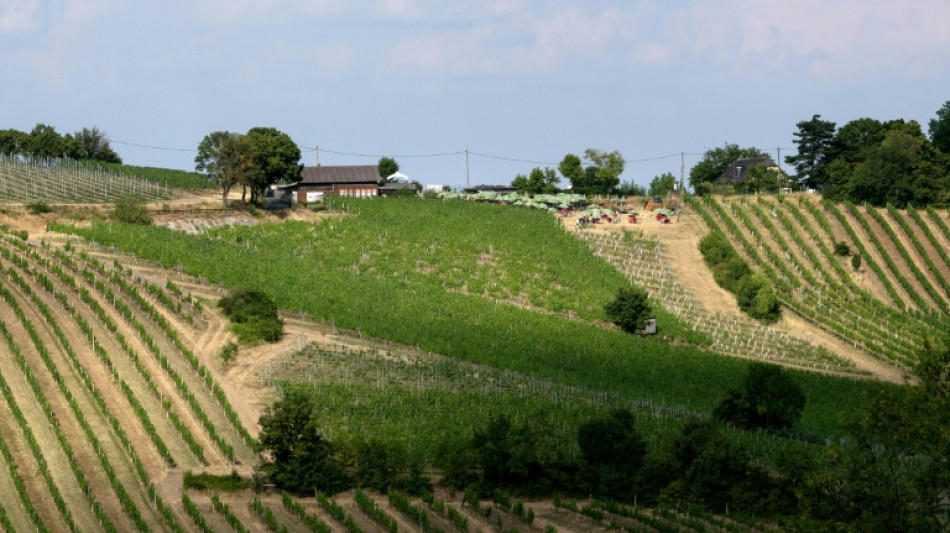
Vienna's venerable vineyard taverns forced to move with the times / Photo: Joe Klamar - AFP

Hospitality veteran Clemens Keller insists that Vienna's storied "heuriger" winemakers' taverns -- which face a hangover-inducing brew of real estate speculation, spiralling costs and climate change -- cannot rely on their illustrious past.
"Whoever does not move with the times will disappear in time," the 42-year-old managing director told AFP.
He was speaking from the shaded courtyard garden of his Mayer am Pfarrplatz heuriger, down the steps from the room where Beethoven stayed while composing part of the Ninth Symphony.
Vienna's heurigers range from a few tables set up in the open air to grander affairs resembling restaurants. For centuries, they have dished up wine from the surrounding vineyards to wash down typically hearty central European fare.
Just as they did in Beethoven's time, euphoric revellers still spill out onto the paths of the otherwise sleepy outskirts in the vine-lined Viennese hillsides after a few carafes of white- or red-wine spritzers.
But despite their beloved place in Viennese life -- the tradition gained UNESCO world heritage status in 2019 -- their ranks have dwindled from 512 taverns in 1956 to fewer than 100 in 2015.
"I think this decline is very regrettable," Tariq Lenny Bas, who grew up among the grapevines of western Austria, told AFP. He was at Mayer am Nussberg, a Keller-run heuriger perched on a hill overlooking the capital, as part of a team-bonding trip with his social media firm.
"And the trend continues," said cultural anthropologist Peter Hoerz. "Inclusion on the UNESCO list is a warning sign -- after all, whatever is listed there is invariably at risk of extinction!"
- 'Adapt or fail' -
While adamant that the tradition would survive, Keller pointed to a "succession problem", with younger generations unwilling to take over a tough family business.
For Jutta Ambrositsch, a pioneering figure among the new wave of Viennese winemakers, "the major problem is insensitive and careless real estate development in the 'heurigen areas'".
Hoerz agreed that Vienna's picturesque winemaking suburbs have become victims of their own success, with their popularity pushing up land prices.
"If a winemaker receives a multi-million-euro offer for their buildings and facilities today, the temptation to give up the business is immense," he added. He argued that the state should shield them from developers.
Anastasia Rentifi, whose PhD research at the University of West Attica in Athens is dedicated to the traditional taverns, also listed "rising operating costs, increasing economic pressure, labour shortages, (and) growing bureaucracy" as commonly cited reasons for packing it in.
On top of that, Vienna's heurigers are seeing their grapes buffeted by ever-more extreme weather, which scientists have long blamed on climate change. The recent June heatwave was Austria's longest-ever for the month.
"Adapt or fail" is Ambrositsch's stark conclusion, which has led her to plant different varieties more resistant to the heat, and to change how she treats the soil.
Keller, for his part, has stepped up irrigation work on his land.
- The heuriger 'reimagined' -
For Ambrositsch and Keller, the key to survival lies in navigating those challenges while refreshing the age-old formula. Ambrositsch, for example, is proud that her heuriger brings together "19-year-old hipsters and 91-year-old widows" at the same table.
Novelties at Mayer am Nussberg that would have bamboozled Keller's ancestors include vegan food, alcohol-free wine -- of which Keller offers four sorts -- and self-service order touchscreens.
"I think my grandmother would have given me a proper telling-off if she'd been told she had to reserve online at the heuriger!" he joked.
But for Hoerz -- who argues that "the heuriger in its 'traditional' form died out by the mid-1990s at the latest" -- change has come at the price of "diversity". The simpler and cheaper wine-gardens are being edged out by "California-style" heurigers and "Oktoberfest" antics, he argued.
What was once an affordable outing for ordinary Austrians has become an upmarket experience "reimagined" for the age of mass tourism, said the anthropologist.
For her part, Ambrositsch credits "removing the bad cliches and stereotypes" -- such as "stupid misogynist musicians" going from table to table and pestering women with outdated and offensive songs -- with keeping the best of the tradition alive.
"If you respect your guests, nothing will die out."
A.Atkinson--MC-UK