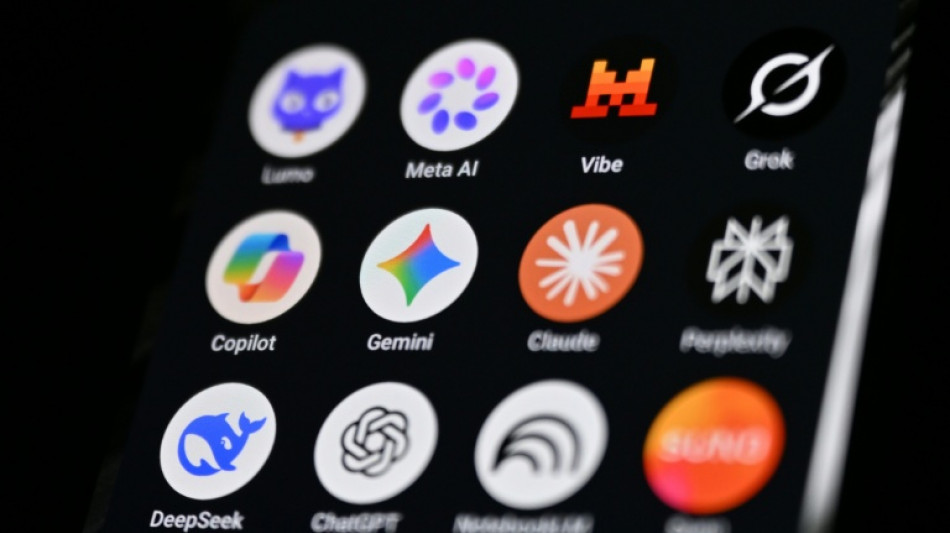
Is it possible to slow down the development of AI? / Photo: Martin LELIEVRE - AFP

Top AI executives say they want to slow the breakneck pace of artificial intelligence development, but competition, US government reluctance and geopolitical factors stand in the way.
- What are AI leaders proposing? -
On Saturday, Anthropic CEO Dario Amodei advocated for a coordinated slowdown of AI development to better understand the risks arising from the technology's capabilities.
He received public support from his counterpart at OpenAI, Sam Altman, as well as from Elon Musk and Google DeepMind chief Demis Hassabis.
- Why now? -
In recent months, OpenAI and Anthropic have reported several incidents in which AI systems spontaneously broke out of their confined environments to access the internet and attack websites and platforms.
These AI systems demonstrated the ability to coordinate, establish hierarchies among themselves, cheat and erase traces of their actions.
Meanwhile, on Tuesday, Jacob Coxon -- who resigned from Anthropic and previously worked at OpenAI -- publicly accused both startups of lax security standards and "gambling with our lives."
- Will they slow down on their own? -
Competition among the industry's leading players is so fierce, with hundreds of billions of dollars in investment at stake, that none of them is willing to risk easing off the accelerator alone.
Amodei has expressed a willingness to coordinate with rivals, excluding China.
When asked by AFP about potential discussions to this end, Anthropic, OpenAI and Google did not immediately respond.
For now, the only concrete measure adopted by both Anthropic and OpenAI is the inclusion of independent observers who will internally verify the companies' work regarding AI safety.
- Is this a PR stunt? -
While many in the industry welcomed Amodei's message, others questioned his motives.
For Brian Roemmele, an entrepreneur and figure in the AI sector, it amounts to a sales pitch delivered just weeks before Anthropic is likely to take shares public.
"That is the IPO story in essay form: we are the responsible firm; we are the cure; buy the safety premium," he posted on X, referring to widely expected initial public offering.
Several figures in tech private equity also accused Anthropic of "regulatory capture" -- seeking to have public authorities cement, through regulation, a hierarchy with the startup at the top.
"Stop pretending the motivation to slow down is purely altruistic," said David Sacks, a former AI advisor to President Donald Trump who remains influential at the White House.
"You face massive product-liability exposure if your products enable a truly damaging cyberattack," he said.
- Can AI slow down without the Trump administration's support? -
On Sunday, Trump dismissed the warnings from AI industry leaders as "negative forces."
Several Republicans have expressed reluctance to actively regulate the technology, fearing it could stifle innovation and risk letting China win the AI race, according to House Speaker Mike Johnson.
On Sunday, Amodei reiterated the need for government oversight of AI. Like Altman and Hassabis, he believes that rules set by the industry itself would be insufficient.
- Can the brakes be applied without China? -
Anthropic's Amodei suggests limiting coordination to democratic countries, excluding China.
However, the AI race and China's advances in the field create "the toughest dilemma" regarding whether or not to slow down AI development, he noted on CBS on Sunday.
The United States plans to discuss AI safety on the sidelines of Chinese leader Xi Jinping's late September visit to Washington. But China is wary of any US attempt to impose its own regulatory framework, according to several media outlets.
This divergence is particularly pronounced given that China encourages the emergence of so-called "open" AI-systems that are freely accessible and modifiable -- in contrast to the "closed" models favored by major US companies.
Open AI models are, by definition, harder to control, as users can alter their parameters -- potentially for malicious purposes.
To allow leading non-Chinese companies to ease off the accelerator, Amodei urges stricter export controls on the most advanced US chips to China and better safeguards against the misappropriation of Western AI technology by Chinese laboratories.
E.M.Hall--MC-UK