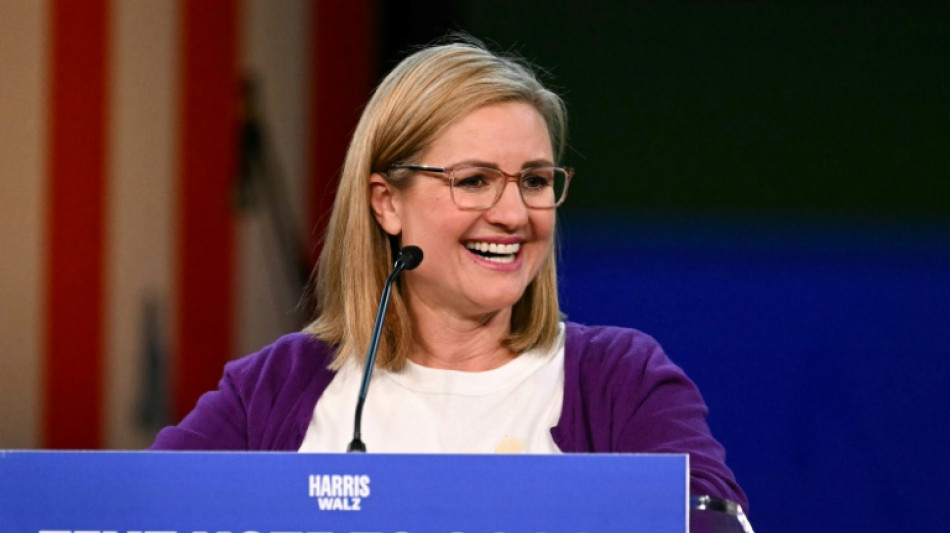
US mayors push back against data center boom as AI backlash grows / Photo: Patrick T. Fallon - AFP
Data centers were supposed to be a gift. In cities across the United States, more and more mayors are treating them like a problem.
With the midterm election season approaching, big tech's promise of a windfall of jobs and tax revenue has given way to talk of polluting gas turbines, strained power grids and a growing sense that the AI revolution is being built on the backs of regular citizens.
The issue has grown large enough to reach the White House, where President Donald Trump this month assembled big tech companies to demand that they bear the exorbitant cost of powering the new data centers breaking ground in communities across the nation.
"Most talk has been, 'hey, this is the future, this is economic development, we need to go as far and as fast as we can,'" Tim Kelly, the mayor of Chattanooga, Tennessee, told AFP on the sidelines of the South by Southwest (SXSW) conference in Austin, Texas.
"I wouldn't say I necessarily disagree with that, but I think now it's starting to get interesting," he added.
At the top of many people's minds is Elon Musk's xAI, which has gone the farthest and at dizzying speed in building AI infrastructure in Memphis and neighbouring Mississippi.
To meet its massive energy demands, xAI has been running at least 18 methane gas turbines at its South Memphis site -- sometimes without permits -- accused of pumping out pollutants in predominantly Black neighbourhoods already burdened by industrial pollution.
This week, Mississippi's environmental regulator gave its green light to the gas generators at a site despite fierce local resistance.
Microsoft, Google, Meta and Amazon are also scouring the country to build out the sprawling windowless concrete structures, driven by the insatiable computing demands of AI.
Phoenix has become a prized destination, thanks to generous tax incentives, low regulation and the construction of new semiconductor plants.
But Mayor Kate Gallego says the local population is growing tired of seeing data centers multiply in their communities, straining water supplies and a power grid that are already at breaking point.
"When you suddenly have transmission equipment in your front yard, that, for many people, does not make it more desirable," she told a SXSW audience.
Her frustration with the industry goes beyond power lines. Arizona's largest utility, APS, says it cannot accommodate all the demand -- if every data center seeking to locate in its service area were approved, electricity demand would reach 19,000 megawatts, more than double the grid's record peak.
"We are in constant battle with our utility provider," said Larry Klein, the mayor of Sunnyvale, in the heart of California's Silicon Valley.
- We are not here -
Gallego said she often discovers a tech company has arrived in town only by checking the utility's latest list of biggest customers -- the result of non-disclosure agreements that leave citizens in the dark until it is too late.
"There's a real spectrum of companies -- some are proud to be your partners, and others would just prefer you not even acknowledge that they're there," she said, pointing to Microsoft and Google as more transparent operators.
Mayors warn that the data center issue is becoming a symbol of Americans' growing doubts about AI more broadly.
An NBC News poll released this month found 57 percent of registered voters saying the risks of AI outweighed its benefits, compared with just 34 percent who said the opposite.
"I'm not a Luddite," Kelly said. "But I do think these are the right conversations to figure out how we manage this."
F.Enfield--MC-UK