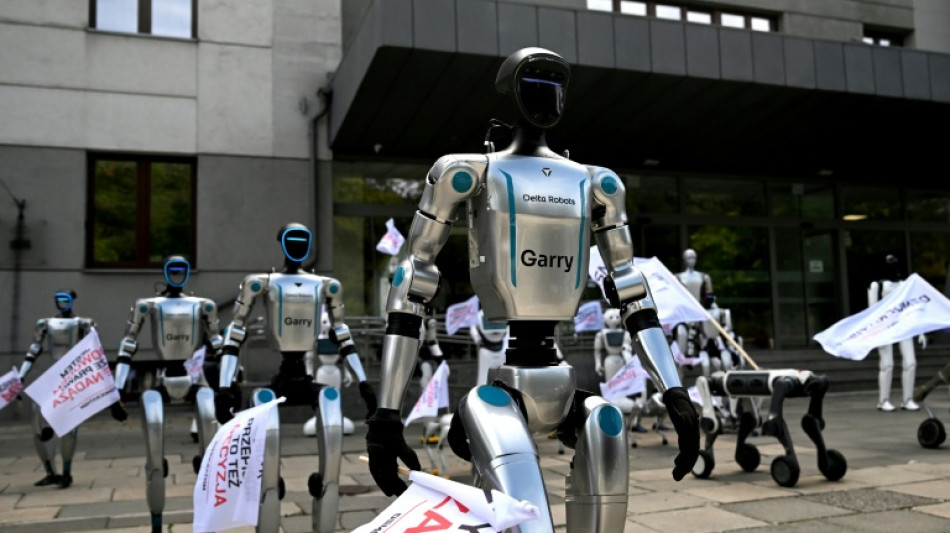
Robots protest rampant AI in Poland / Photo: Sergei GAPON - AFP

Waving flags, "chanting" slogans, and marching in circles: around 30 robots took to the streets of Warsaw on Monday to campaign for AI regulation in front of the Polish digital affairs ministry.
The protest was organised by Democratism, an initiative that, according to its website, aims to launch debate "on how AI and robotisation affect the labour market".
"The robots present here are meant to show that this technology is already a reality," Agibot A3, one of the AI-powered humanoid robots, told AFP.
Chants of: "Defend workplaces", "Time for rules", and "Don't wait, regulate" played on loudspeakers as the robots -- which ranged from bipedal humanoids to dog-like quadripeds -- demonstrated.
"We particularly want to address the issue of the potential replacement of people both by humanoid robots and by artificial intelligence in cognitive work," organiser Grzegorz Kulis told AFP.
"If we don't react now, we may soon have a problem," he added, emphasising the need for "rules and regulations that would serve as a shield protecting workers".
Aside from attracting the attention of several passers-by, Kulis said the use of robots was meant to show their existing capabilities and thereby, the urgency of the situation.
"These robots can already move around freely, they're already 'protesting'", he said.
The marching robots were met with a visit from Poland's Digital Affairs Minister Krzysztof Gawkowski, who spoke to Kulis on site.
"Uncontrolled (AI) models, implemented into humanoids that will also keep evolving as robotisation moves forward, are a major problem," he said.
Kulis, who is now the CIO of a robotics company and CEO of an employment agency, served two terms on the Labor Market Council at the Ministry of Family, Labor and Social Policy.
"We feel responsible for starting to inform society about the rapid and dynamic technological changes which personally frighten us," he told AFP.
In July, Poland's conservative-nationalist president Karol Nawrocki signed into law a bill put forth by the ministry putting the EU's AI Act into practice.
It created a national authority capable of enforcing existing EU regulations, which had already formally come into force.
A.Davidson--MC-UK