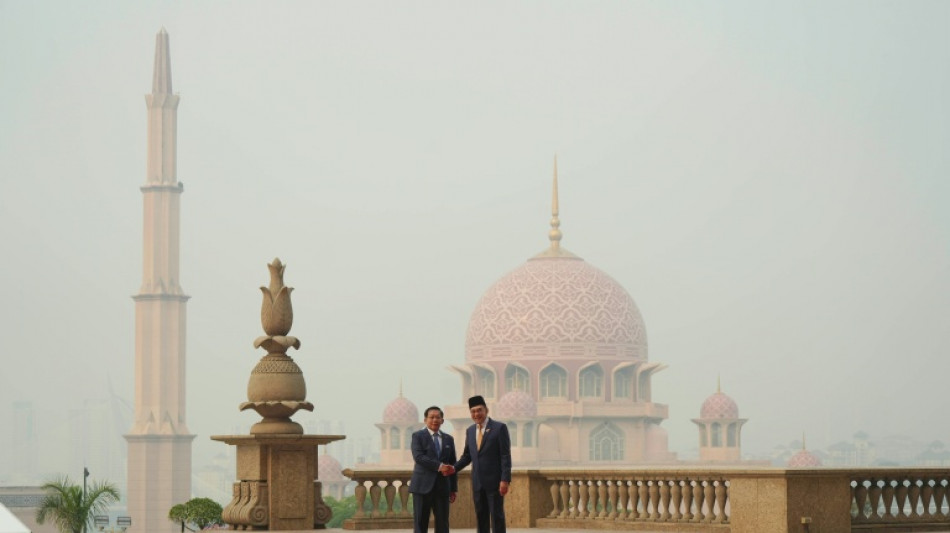
From refuge to repatriations: Malaysia's Myanmar U-turn / Photo: Azneal Ishak - POOL/AFP
Malaysia's Prime Minister Anwar Ibrahim once urged his Muslim-majority nation to show solidarity with the persecuted Rohingya who fled Myanmar en masse, but this week rolled out the red carpet for the man accused of orchestrating their genocide.
Min Aung Hlaing touched down on Wednesday, invited for a two-day visit to discuss thousands of Myanmar migrants being sent back under a repatriation scheme touted by Anwar.
Malaysia has historically offered safe haven to those exiled from Myanmar by persecution or conflict.
The nation hosts 190,000 Myanmar refugees or asylum seekers according to the United Nations (UN), two-thirds of them from the Muslim Rohingya ethnic group.
But experts say fears that they burden Malaysia have been amplified by a cocktail of misinformation and an embattled Anwar, who hopes to capitalise on anti-Rohingya sentiment ahead of upcoming elections.
To carry out the repatriation plan, he has welcomed Min Aung Hlaing -- previously shunned and credited with ordering the 2017 crackdown that sent legions of Rohingya fleeing to Malaysia in the first place.
- Domestic hostility -
Myanmar says it has repatriated around 8,000 citizens by air and 1,500 by sea so far this year, while Malaysia announced it is preparing 3,500 more to go back.
Kuala Lumpur has declined to say what proportion of returnees are Rohingya.
But experts say Malaysian attitudes towards migrants, particularly the Rohingya, soured during the Covid-19 pandemic when they became targets of misinformation about the disease.
"That hostility did not simply disappear afterwards," Khoo Ying Hooi, an associate professor at Universiti Malaya, told AFP.
"This year there was another very visible surge in anti-Rohingya rhetoric online, alongside harassment."
Newer resentments include claims that Malaysians are losing jobs to migrants, as well as the narrative that they are straining public resources or involved in crime.
"The early sympathy was very strong because Malaysians largely encountered the Rohingya through the language of persecution," said Khoo.
"They were Muslims fleeing horrific violence in Myanmar, so religious solidarity and humanitarian sympathy came together quite naturally."
But James Chin, a Malaysia expert at the University of Tasmania in Australia, said the nation was now dealing with popular backlash against "allowing too many Rohingya to come".
"This is ironic, because the only reason they were allowed to come in the first place is due to Islamic solidarity," he told AFP.
"It has now changed completely the other way around."
- 'Election ploy' -
In the past, Anwar appealed to Malaysians for solidarity towards migrants who fled upheaval in Myanmar credited to Min Aung Hlaing.
He was the leader of the military when it began a 2017 crackdown evicting Rohingya in droves from their homes in western Myanmar.
The campaign is currently being weighed as a potential genocide by the International Court of Justice, but many rights monitors and some nations already deem it one.
Anwar's about-face welcoming of Min Aung Hlaing and returning back migrants is partially due to a shift in domestic politics, experts say.
His Pakatan Harapan coalition has suffered setbacks in recent state elections in the runup to regional and national polls, which must be held by February 2028.
Among their defeats were losses to a coalition fronted by the United Malays National Organisation, a formerly dominant party which draws much support from the Malay majority.
Yap Lay Sheng, a senior human rights specialist with NGO Fortify Rights, said Anwar's repatriation push was an "election ploy" to court the vote of ethnic Malays.
"Anwar is being outflanked from the right in Malaysia. The conservatives and the nationalists have fashioned themselves as champions of the Malay majority interests."
Targeting immigrants allows him "to be seen as a defender of the collective interest against outsiders", said Yap, a powerful message for political campaigning.
- 'Greater scrutiny' -
Malaysia says all migrants despatched home have been sent from detention centres where they made voluntary decisions to return to Myanmar.
But the UN has panned the scheme for being opaque and failing to provide guarantees of safety on return, as required by international law.
Min Aung Hlaing staged a 2021 coup which plunged the country into a grinding civil war, causing a fresh wave of upheaval sending yet more citizens fleeing abroad.
He is now making a push to normalise diplomatic ties after being installed as civilian president in April, following elections staged by his military junta and derided by democracy watchdogs.
Deals with him to return migrants may improve Anwar's electoral prospects at home, but experts say it could tank Malaysia's credibility abroad.
The repatriation came days after Malaysia spoke at the United Nations General Assembly, advocating for international law to come to the aid of Palestinians -- a majority Muslim group.
"Malaysia speaks so strongly about the protection of civilians, humanitarian principles and the consistent application of international law in Palestine," said Khoo of Universiti Malaya.
"There will inevitably be greater scrutiny of how those same principles are applied closer to home."
burs-llk/jhe/lkd/jm
W.Elffire--MC-UK