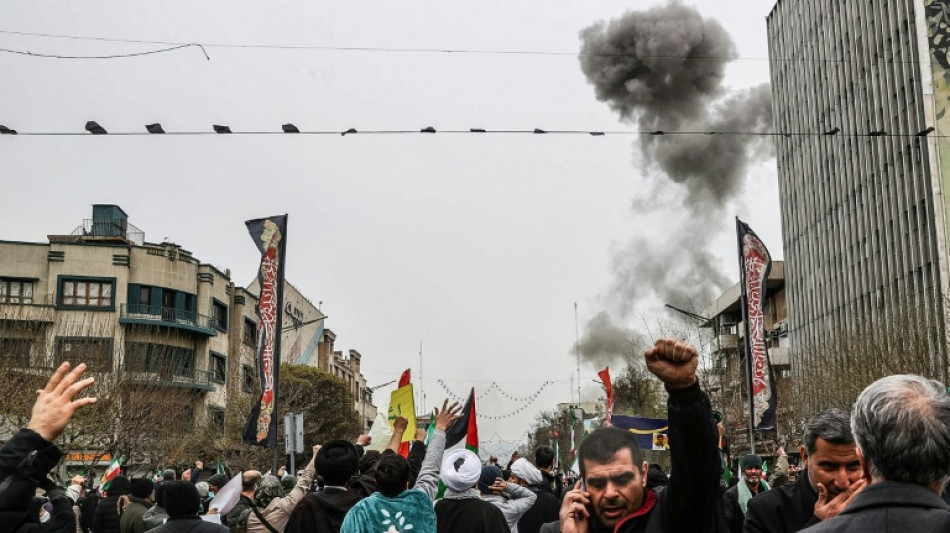
Iran defiant, US vows even heavier bombing / Photo: Mohammad Mahdi DEHGHANI - FARS NEWS AGENCY/AFP
Iranian officials led a pro-government rally as explosions rocked Tehran on Friday, while the US vowed to intensify its bombing and President Donald Trump said it was his "honour" to be killing the Islamic republic's leaders.
The hardline stances -- and fresh strikes unleashed by Israel and Iran -- presaged no let up in the conflict engulfing the Middle East and roiling the global energy market as it is about to enter its third week.
AFP journalists in Tehran reported loud blasts over the city skies, as Israel's military said it had hit more than 200 targets in western and central Iran in the past day.
US Defense Secretary Pete Hegseth told a news conference the US military would bombard Iran more heavily on Friday than any other day so far in the war.
He also said Iran's new supreme leader, Mojtaba Khamenei, was "wounded and likely disfigured" in the February 28 attack that killed his father and predecessor Ali Khamenei at the start of the US-Israeli campaign.
President Donald Trump said on social media he viewed it "a great honour" to be killing Iran's rulers, calling them "deranged scumbags".
The United States will be hitting Iran hard over the "over the next week", Trump told Fox News Radio.
- Fresh strikes -
While Mojtaba Khamanei has not been seen in public since being named supreme leader, other Islamic republic officials defiantly walked with pro-government demonstrators who waved flags and brandished banners reading "Death to America" and "Death to Israel".
Iran's state media said at least one woman was killed when blasts hit an area near the demonstration.
"These attacks are out of fear, out of desperation," said Ali Larijani, secretary of the Supreme National Security Council, who attended the rally to mark Quds Day, the last Friday of Ramadan and a day of support for the Palestinian cause.
"One who is strong wouldn't bomb demonstrations at all. It's clear that it (the enemy) has failed," said Larijani in a speech broadcast on state TV.
President Masoud Pezeshkian and Foreign Minister Abbas Araghchi also attended the rally, while images on Iranian media showed the head of the judiciary being interviewed just as a blast occurred.
Shortly afterwards, state television said Iran had launched a fresh salvo of missiles at Israel.
Iran has launched waves of drone and missile strikes against neighbouring states hosting US military assets throughout the region.
Saudi Arabia's defence ministry said Friday its forces had intercepted dozens of drones, including one targeting its capital's Diplomatic Quarter.
An AFP journalist also reported an explosion heard over Dubai, while Turkey said NATO forces shot down a ballistic missile launched from Iran.
- Oil worries -
The conflict has sparked chaos on global markets and sent oil prices soaring.
Iran's Revolutionary Guards have all but closed the strategic Strait of Hormuz in the Gulf through which 20 percent of global oil supplies pass.
While it dipped back under $100 a barrel on Friday, markets and governments everywhere are skittish about the consequences of higher inflation.
"Every day on the ship, I can see missile launches and hear explosions, making me feel like I was in danger," a sailor stuck on one of the ships unable to pass through the Strait of Hormuz, Wang Shang, told AFP.
US Energy Secretary Chris Wright said on Thursday that US Navy escorts would likely not be able to escort ships through the strait until the end of the month.
A message read out in Mojtaba Khamenei's name on Iranian state television said that "lever of blocking the Strait of Hormuz must definitely be used".
- Bread rationed -
Within Iran, the Revolutionary Guards have warned that any fresh anti-government protests in Iran would be met with a stronger response than when they last took place January, when several thousand people were killed.
Iranians speaking to AFP under cover of anonymity have painted a grim picture of life under the bombs, with cities in ruins and cash running short.
"People are desperately trying to withdraw their savings from the banks," one 30-year-old woman in Kermanshah, western Iran, told AFP.
"Bread is now rationed. The population is extremely tense and outraged."
The UN refugee agency has estimated that up to 3.2 million people have been displaced inside Iran since the war started.
Iran's health ministry said on March 8 that more than 1,200 people have been killed, a figure AFP has not been able to verify independently.
The US military has lost 13 personnel since the war started -- including all six members of a refuelling aircraft it said crashed in Iraq after an incident it said was not caused by hostile fire.
Pentagon chief Hegseth said the US and Israel have so far struck more than 15,000 targets.
In another sign of the war's spread, President Emmanuel Macron announced the death of France's first soldier, in an attack in the Erbil region of Iraq.
In Israel, a strike on the town of Zarzir injured around 60 people, according to police, with AFP images showing burned-out vehicles and craters in the ground.
The conflict has also battered Lebanon, with authorities reporting at least 687 people killed by Israeli attacks.
AFP images from central Beirut showed buildings reduced to husks of rubble and burned-out shells of overturned vehicles as small fires flickered from the aftermath of strikes.
Israeli planes dropping propaganda leaflets over Beirut caused a number of loud booms in the sky, terrifying residents.
burs-rmb/ser
R.Berrycloth--MC-UK