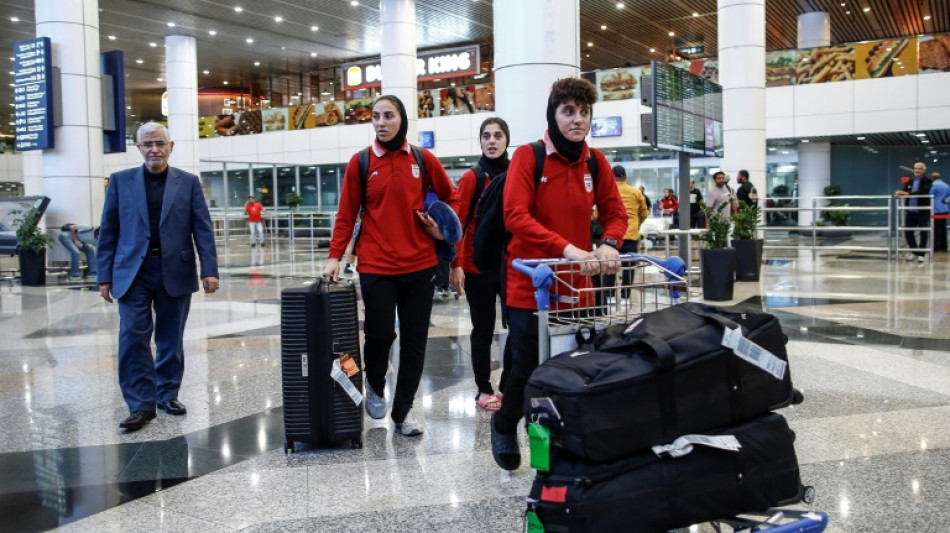
Iran says women's football captain withdraws Australia asylum bid / Photo: ARIF KARTONO - AFP/File

The captain of the Iranian women's football team which played in the Asian Cup in Australia has withdrawn her bid for asylum, state media said Sunday, making her the fifth member of the delegation to change her mind.
A former player and a Persian-language TV channel based outside Iran said the players had been pressured to reverse their stance through threats against families back home. But Iranian authorities have in turn accused Australia of pressuring the players to stay.
Captain Zahra Ghanbari, a striker and the national team's top goalscorer, has withdrawn her asylum application and will now head from Australia to Malaysia and from there fly back to Iran, the state-run IRNA news agency said.
Three players and one backroom staff member had already in previous days withdrawn their bids for asylum and travelled to Malaysia.
Seven members of Iran's visiting football delegation competing in the Women's Asian Cup had sought sanctuary in Australia after they were branded "traitors" at home for refusing to sing the national anthem.
The football drama has unfolded against a backdrop of war in the Middle East unleashed by US-Israeli air strikes on Iran, which also followed protests against the clerical system that peaked in January.
Following the captain's reported move to go back on her asylum request, only two of them are now set to remain in Australia. The players returning to Iran were at a hotel in the Malaysian capital Kuala Lumpur awaiting their onward travel.
There was no immediate comment from Australian authorities on Ghanbari's situation.
Last week one player had changed her mind, followed by two players and the one staff member who left Australia on Saturday.
Australia Home Affairs Minister Tony Burke said in a statement that day that "three members of the Iranian Women's Football Team made the decision to join the rest of the team on their journey back to Iran".
He said that after informing Australian officials of their decision "the players were given repeated chances to talk about their options", he said.
The Australian government gave team members the opportunity to seek refuge but players faced "incredibly difficult decisions", the minister said.
- 'Cruelty and desperation' -
But Shiva Amini, a former Iranian national futsal player who now lives in exile, wrote on X that she had heard information that Iran's Football Federation, working with the Revolutionary Guards, "placed intense and systematic pressure on the players' families in Iran".
Amini, who herself left Iran after a controversy involving not wearing the hijab, said that authorities pressured the mother of Ghanbari and added this "shows the level of cruelty and desperation they are willing to use to force these athletes to comply".
Opposition television channel Iran International said it had also received information that the families have been threatened, with Ghanbari's mother summoned by the Guards' intelligence branch at home and her daughter then informed of the interrogation.
Rights groups have repeatedly accused Iranian authorities of pressuring athletes abroad by threatening relatives or with the seizure of property if they defect or make statements against the Islamic republic.
Iranian media reports hailed her move, with IRNA saying she was "returning to the embrace of the homeland" and the Mehr news agency describing it as a "patriotic decision".
Australian Prime Minister Anthony Albanese had lauded the bravery of the women, vowing they would be welcomed with open arms.
The Iranian players caught international attention when they fell silent as the national anthem played ahead of a tournament match in Australia, an act viewed as a symbol of defiance against the Islamic republic.
The side in later matches sang the Islamic republic's anthem.
A presenter on Iranian state TV branded the players "wartime traitors", fuelling fears they could face persecution, or worse, if they returned home.
I.K.Holmes--MC-UK