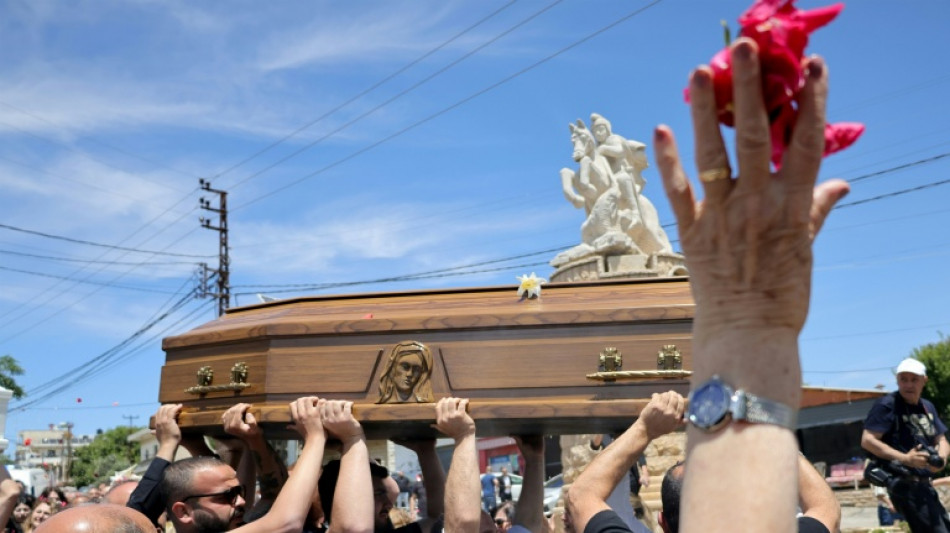
Israel strikes Lebanon after 'last chance' truce announcement / Photo: - - AFP
Israel carried out new strikes in Lebanon on Thursday and again threatened Beirut, despite the two countries agreeing to a conditional ceasefire that Lebanon's president called the "last chance" for a durable end to the fighting.
A United Nations peacekeeper was killed and two others were wounded, the UNIFIL force said, after a base was hit the previous night in the south, where Israel and the Iran-backed militant group Hezbollah are fighting.
Belgrade said the slain peacekeeper was Serbian, with seven blue helmets now killed since the latest war erupted in March.
Envoys from Israel and Lebanon held a fourth round of talks in Washington on Wednesday, agreeing to implement a ceasefire hinged on Hezbollah halting its attacks.
Lebanese President Joseph Aoun said the deal represents "the last chance to enter into a final, comprehensive ceasefire".
"Each party bears responsibility" if it fails to respond positively, he added, saying Lebanon would inform Washington once it had received Hezbollah's position.
The US would determine the truce's start date, he continued, with President Donald Trump to serve as "the direct guarantor of its implementation".
Israeli Defence Minister Israel Katz said Thursday that the army will "at this stage, continue its fire and ground operations... without the return of the population, while continuing to dismantle terrorist infrastructure".
Israeli forces retain the "freedom of action, with American backing, to strike in Beirut in response to fire on Israeli communities and territory", he added.
Hezbollah, which rejects the direct talks, has not commented, but its chief Naim Qassem is due to release a statement later Thursday.
Esmail Qaani, the head of Iran's Quds Force -- the foreign arm of its powerful Revolutionary Guards -- insisted Israel withdraw to its pre-war positions in Lebanon as a "minimum demand", adding that "supporting the resistance in Lebanon is the duty of all of us".
Hezbollah drew Lebanon into the wider Middle East war on March 2 with rocket fire at Israel to avenge the killing of Iran's supreme leader in US-Israeli strikes.
It has vowed to keep fighting despite a push by the Lebanese government to disarm it.
- 'Words on paper' -
Mohammad Chamseddine, 56, from Beirut's southern suburbs, told AFP that "this isn't the first time there's been a ceasefire and Israel violates it".
An April 17 truce was meant to halt the fighting and was extended several times but has never been observed, with both sides justifying their ongoing attacks by the other's alleged violations.
As an Israeli drone buzzed overhead, Chamseddine said the ceasefire for now was just "words on paper. I won't believe it until I see it on the ground. How can a ceasefire be on one side only?"
Lebanon's state-run National News Agency (NNA) reported around 20 strikes in Lebanon's south and east on Thursday, some causing casualties, including a couple and their daughter who were wounded in an attack on their car.
Israel's military renewed a warning to Lebanese not to cross the Zahrani River, around 45 kilometres from the border, after it last week declared all areas south of the river "combat zones".
- 'Serious mistake' -
Earlier Thursday, the Israeli military said air raid sirens sounded in northern Israel, with one incident involving a "suspicious aerial target" resolved, while another incident was found to be a false alarm.
Hezbollah on Thursday claimed several attacks on Israeli troops who have invaded south Lebanon.
Israel's far-right National Security Minister Itamar Ben Gvir criticised the latest deal, calling it a "serious mistake".
According to a statement issued after the meeting in Washington, the two sides -- which do not have diplomatic relations -- agreed to create "pilot zones" in which the Lebanese army "will take exclusive control of the territory to the exclusion of all non-state actors".
Katz said the ceasefire stipulates the "removal of Hezbollah terrorists from the entire area south of the Litani River and the creation of a demilitarised zone" there, referring to a waterway around 30 kilometres from the border.
Senior Hezbollah official Mahmud Qomati had told AFP this week that the group would "not accept a partial ceasefire".
On Wednesday, Trump said he wanted to separate talks on the Lebanon conflict from those on the Iran war.
Tehran, however, insists they are linked and its Foreign Minister Abbas Araghchi warned that any attack on Beirut would trigger a "full-scale resumption" of war.
burs-lg/smw
A.Edwards--MC-UK