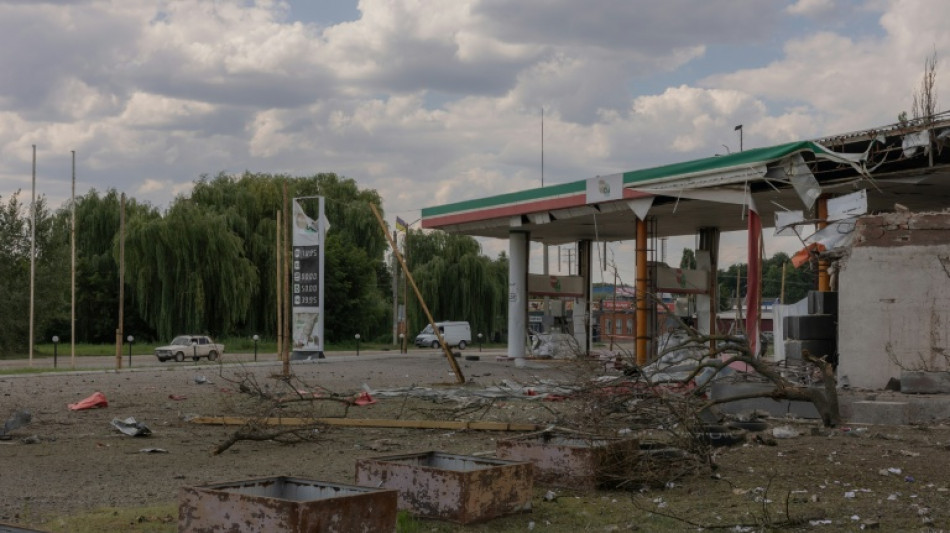
'To make the civilians leave': Russia pummels Ukraine's petrol stations / Photo: Roman PILIPEY - AFP
A streak across the sky, then a muffled blast. Near Izyum in eastern Ukraine, another petrol station has just been blown to pieces.
The scene has become commonplace as Russia multiplies its strikes against the country's logistics infrastructure.
Since July, Moscow has hit more than 200 petrol stations across, according to Ukrainian media. Most are in the east and northeast along logistics routes leading to the front.
Looking at a car riddled with shrapnel holes and stretch of twisted metal sheets, David Akopyan was wandering among the ruins of what was once his workplace.
A few minutes before the strike, the 35-year-old attendant had closed the station because of the risk of bombardment.
"I put up the barrier tape, cleared everyone out, and had barely reached my car when I heard the whistle of the missile," he told AFP, pointing to a small building ripped open by the blast.
Around him, the concrete blocks meant to shield the premises that proved useless.
Peppered with shrapnel and emerging out of rubble, a sign continues to display the price of unleaded petrol.
"I think we only have two or three stations left in town," Akopyan said, looking somewhat lost.
Since launching its full-scale invasion in 2022, Russia has regularly targeted Ukraine's energy capabilities -- thermal power plants, gas distribution and pipelines.
But in recent months it is regular petrol stations that have been in Moscow's sights.
- 'As difficult as possible' -
With the advent of drones, the two countries are increasingly targeting each other's military logistics, particularly roads and supply hubs.
But the Russian attacks on roadside petrol stations "have no impact whatsoever" on the military since the "defence ministry has its own fuel supply system," Ukrainian energy analyst Sergiy Kuiun told AFP
Ukraine's energy ministry suspects the aim is more cynical.
"These strikes are intended to damage civilian infrastructure, disrupt logistics, and make the humanitarian and economic situation as difficult as possible ahead of the coming winter, as well as to worsen the provision of essential services for communities," it told AFP in written comments.
The campaign has forced a cat-and-mouse-like game for the station operators, who have managed to restore around 80 percent of the damaged pumps to service, said Kuiun.
In Izyum, some 30 kilometres from Russian troops, air raid sirens sound multiple times a day, temporarily closing the stations.
Explosions echo in the distance.
Near a petrol station draped in anti-drone netting, an employee casually smoked a cigarette, waiting for the alert to be over.
Civilians and soldiers, sat behind the wheels of the vehicles, lined up, waiting for the pumps to reopen.
- Sowing panic -
Several civilians, as well as journalists, have been killed in the strikes on petrol stations across Ukraine in recent months.
Along the roads around Izyum burnt-out shells of petrol stations have become part of the landscape, heaps of mangled, charred metal.
Residents of the garrison town told AFP they feared being unable to obtain enough fuel if they suddenly need to evacuate.
Some have begun building up reserves, while others are already considering leaving because of the risk of shortages.
Ukraine alleges the strikes are also accompanied by a "large-scale media campaign" by Russia aimed at "sowing panic and discouragement among the population".
The country's stations also serve as restaurants, meeting places and sometimes even bars, frequented by some military personnel but mostly civilians.
Some stations more than 200 kilometres from the front line bear the scars of recent drone strikes.
Worker Akopyan, a former soldier, tried to remain outwardly calm.
"Even if they bomb all the stations, there will be options for how to supply fuel ... one way or another, we'll keep working."
But he admitted he worries what might happen if the campaign intensifies.
"For now, they are trying to drive all the civilians out of the town ... Then they'll just wipe everything out."
D.Walsh--MC-UK