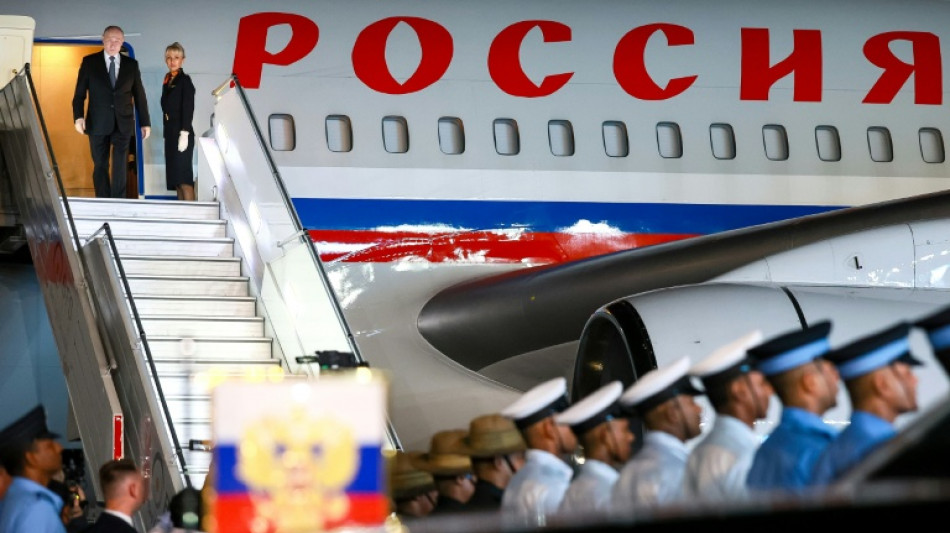
Putin in India for BRICS summit overshadowed by war / Photo: Vladimir SMIRNOV - POOL/AFP
Russian President Vladimir Putin was in India on Friday for talks ahead of an 11-member BRICS summit dominated by conflict and economic challenges, with the leaders of China and Iran set to attend.
Wars in the Middle East and Ukraine, as well as global trade turbulence and oil are expected on the agenda at the two-day annual summit that opens on Saturday, when Chinese President Xi Jinping is set to arrive.
It will be Xi's first visit to India since 2019, and marks the biggest step yet in a cautious thaw between the rival neighbours, six years after a deadly military clash along their disputed Himalayan border.
Ties between the nuclear-armed Asian giants have been warming again recently, with flights, visas and high-level contacts gradually being restored.
However, deep mistrust remains, with their contested frontier, a widening trade deficit and strategic rivalry still complicating ties.
"One should engage in debate and friendship only with the virtuous, and nothing whatsoever with the unvirtuous," Indian Prime Minister Narendra Modi wrote Friday, in a message in Sanskrit to welcome arriving leaders on social media.
Modi is due to hold talks later on Friday with Putin, who last visited India in December 2025. Moscow is one of New Delhi's most important strategic partners.
India has navigated the energy crisis sparked by the Iran war in part by turning to Russia, its most controversial fuel supplier in recent years.
Iranian President Masoud Pezeshkian is also expected on Friday, and is due to hold talks with Modi.
- 'Fault line' -
Posters of a beaming Modi line streets across New Delhi to welcome the leaders, with heavy deployments of security forces across the capital and widespread traffic restrictions.
BRICS was created in 2009 as a forum for major emerging economies seeking greater influence in institutions dominated by Western powers.
It has since expanded and now includes Iran, Saudi Arabia and the United Arab Emirates -- three countries with sharply differing positions on the war launched by the United States and Israel in February.
"The Gulf conflict is going to be the central fault line this time during the BRICS summit," said Harsh V. Pant of India's Observer Research Foundation.
"What was seen until last year as an achievement -- the expansion of BRICS -- today looks like a big constraint on BRICS," Pant said.
It will be Pezeshkian's first visit to India as Iranian president, and will put the Middle East conflict firmly on the agenda.
"The war in Iran will provide a stern test of the (expanded) group's cohesion," said Shilan Shah of Capital Economics, noting the failure of the BRICS foreign ministers to agree on a joint statement when they met in New Delhi in May.
United Arab Emirates President Mohamed bin Zayed Al Nahyan is also expected, as is Saudi Foreign Minister Prince Faisal bin Farhan, and Egyptian President Abdel Fattah El-Sisi.
India maintains cordial relations with Iran and Israel, but is also careful to strike a delicate balance in its ties with Washington.
New Delhi has navigated the energy crisis caused by the Iran war in part by turning to Russia, one of its most important strategic partners and its most controversial fuel supplier in recent years as the war against Ukraine drags on.
Indian Foreign Minister Subrahmanyam Jaishankar visited Kyiv this month, when Ukrainian President Volodymyr Zelensky said he was "grateful to India for its commitment to ending this unjust war".
burs-pjm/cms
R.Gibson--MC-UK


