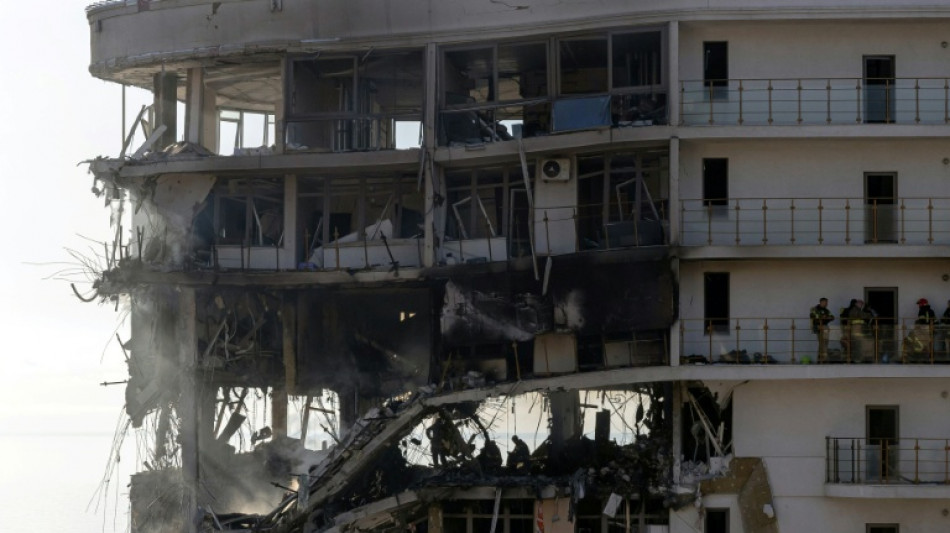
Ukraine's economy hobbled by Russian strikes / Photo: Oleksandr GIMANOV - AFP
Ukraine's economy is being crippled by intensifying Russian strikes hitting key sectors and its GDP could slump by 1.5 points in 2026, Kyiv officials said Saturday, warning of a "very difficult" winter ahead.
Russia, which devastated Ukraine's energy sector during the course of 4.5 years of war, has since this summer stepped up a campaign of missiles and drones that Kyiv is struggling to intercept.
These have severely restricted grain exports in the Black Sea -- a crucial source of Kyiv's revenue.
The strikes have also targeted steel companies, another key sector, as well as supply chains -- notably in the rail sector -- and major warehouses.
"The economy is in the most difficult situation," Ukraine's Prime Minister Sergiy Koretsky said during the annual Yalta European Strategy forum in Kyiv.
He said the intensity of the strikes and the level of destruction have increased.
"We anticipate a very difficult winter in terms of both critical infrastructure, which is being destroyed every day by Russian attacks, but also in terms of overall economic conditions in the country," said Ukraine's economy minister, Oleksandr Kravchenko.
Kyiv estimates that "the total destruction of infrastructure and assets are likely to be close to $10 billion" this year.
This destruction and the blockage of seaports are likely to reduce national GDP by 1.5 points, he added, with some Western experts calling the situation "catastrophic."
- Rising war costs -
Roksolana Pidlasa, the head of the budget committee in Ukraine's parliament, described a bleak outlook.
"It can get worse, but it's already bad now," she told the same forum.
"Russia specifically targets revenue-generating industries by attacking grain corridors, by attacking seaports and metallurgical plants," she said at the same forum.
"It is not something that you could reconstruct quickly."
Ukraine's largest steelworks, ArcelorMittal Kryvyi Rig, said Saturday that a Russian missile strike killed two of its workers and damaged facilities.
Kyiv has also upped its retaliatory strikes on Russia, targeting oil facilities, factories and warehouses.
President Volodymyr Zelensky hopes his US counterpart Donald Trump will pressure Russia to ensure Black Sea ports reopen and for a mutual suspension of strikes on energy sites.
He warned of the risk of food crises in African and Asian countries, saying Moscow was also unable to export its grain through the Black Sea. Both countries are key global suppliers of grain.
- Food and energy truce -
"At the very least, again, if peace is impossible from today... we can at least resolve the issue of an energy truce, a food truce, food security; such decisions can be made," he told the Kyiv forum this weekend.
He called on resolving these "now" and "not in winter".
At the same time, Kyiv's military spending is rising.
Pidlasa said that in 2024 "one day of war costs 140 million US dollars per day, this year it costs 190 million dollars a day."
Kyiv, she said, has had to start using international aid this year to even pay its soldiers' wages.
The release of nearly $30 billion in international aid intended to finance this year's budget deficit is conditional upon parliament passing draft laws demanded by Western countries, Koretsky said.
These include anti-corruption measures after Ukraine was hit by several large-scale graft scandals during the war with Russia.
But parliament is struggling to approve suggested laws, which include unpopular measures such as imposing duties on parcels from abroad, intended to boost revenues.
P.Wright--MC-UK