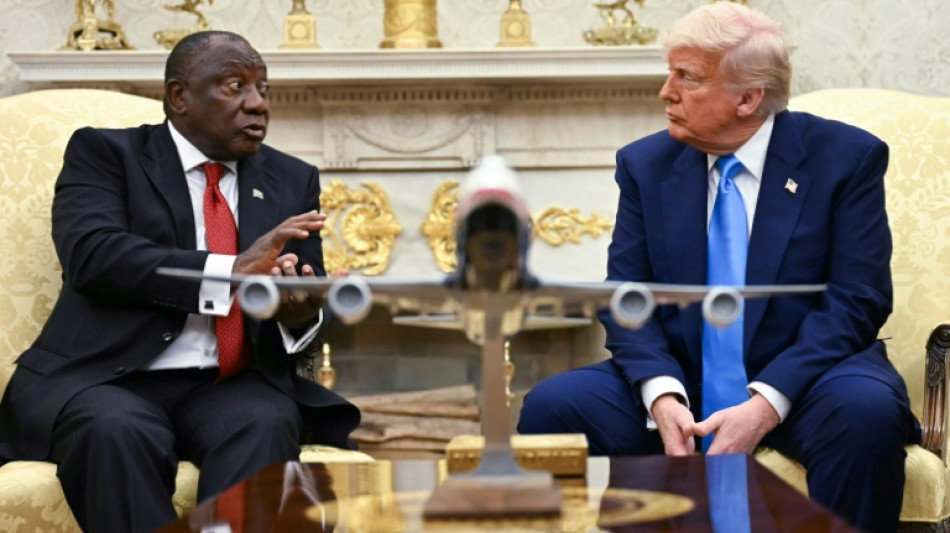
From land to race laws: what's driving the US-South Africa rift? / Photo: Jim WATSON - AFP/File
The Trump administration this week announced visa restrictions on South African officials over alleged discrimination against the country's white minority, warning that the move was the opening salvo in a series of potentially "severe" punitive measures.
The latest escalation marks another chapter in a deteriorating relationship between Pretoria and Washington, which have repeatedly clashed over a range of policy issues.
Among the most significant sources of friction are:
- Land expropriation -
A major flashpoint has been South Africa's Expropriation Act, signed into law in 2025 to replace an apartheid-era statute and align land acquisition rules with the post-apartheid constitution.
When still a self-governing dominion under British rule, South Africa's 1913 Natives Land Act restricted black people from buying or occupying land and thousands of families were forcibly moved.
Its legacy is that white people -- about seven percent of the population -- owned 72 percent of farmland in 2017, according to government figures.
The new law allows the government to acquire private property for public purposes or in the public interest, including, in limited circumstances, with no compensation.
Critics, particularly among white farming groups, say the measure opens the door to land seizures. Legal experts note, however, that compensation can be set at zero only in narrowly defined cases, such as abandoned, derelict or over-indebted land, and is not a blanket provision for expropriation without payment.
US Secretary of State Marco Rubio on Tuesday nonetheless characterised the law as allowing the government to seize land without compensation, a description Pretoria rejected as misrepresenting its purpose.
"We reiterate that healing the divisions of the past and establishing a society based on democratic values, social justice and fundamental human rights is a constitutional imperative," South Africa's foreign ministry said.
No expropriation has yet been carried out under the new law.
- Crime -
South Africa has a serious violent-crime problem, with an average of about 60 murders a day, giving it one of the highest murder rates in the world.
Fringe far-right groups among white South Africans have propagated the theory of a "white genocide", a claim backed by Trump financial backer Elon Musk, who was born in South Africa, arguing that the government is complicit in farm murders.
Rubio said the South African government has consistently failed to address the "rural crime, violent and dehumanising rhetoric" directed at Afrikaners, the descendants of Dutch settlers.
Pretoria, however, said it "remains seized with the challenges of crime" and that criminal violence does not target anyone on the basis of race.
The vast majority of murder victims in South Africa are black. According to the latest police data, 5,427 murders were recorded between April and June this year, while police said only one farm murder was recorded during the same period, without specifying the victim's race.
Data collected by white farmers themselves does not support claims of a genocide. The Transvaal Agricultural Union of South Africa (TAU SA), which represents mainly Afrikaner farmers, said it recorded 1,455 farm murders between 1990 and 2025, an average of about 41 a year.
- Black empowerment laws -
Introduced in 2003, Broad-Based Black Economic Empowerment (B-BBEE) uses a points-based scorecard to encourage companies to increase black ownership and management representation, develop skills and procure from black-owned businesses. The policy was designed to expand black participation in an economy where ownership and opportunity were heavily restricted under apartheid.
The framework also includes equity-equivalent programmes, allowing multinationals to meet certain empowerment requirements without transferring ownership. American companies including Microsoft and Google already operate in South Africa under such arrangements.
Washington opposes the use of race in determining economic opportunities, and Musk has claimed B-BBEE rules are the reason Starlink has not secured a licence to operate in South Africa.
In July, Starlink rival, Amazon Leo, backed by American billionaire Jeff Bezos, said it would launch satellite internet services in South Africa in 2027 through a partnership with a local provider.
The US Ambassador to South Africa Brent Bozell has called for American companies to be exempted from the B-BBEE requirements.
"This visa restriction policy is only the first step in a series of escalatory measures that will show America's firm resolve in this matter," he said on Wednesday.
B-BBEE has also been criticised at home and is currently under review.
W.Elffire--MC-UK