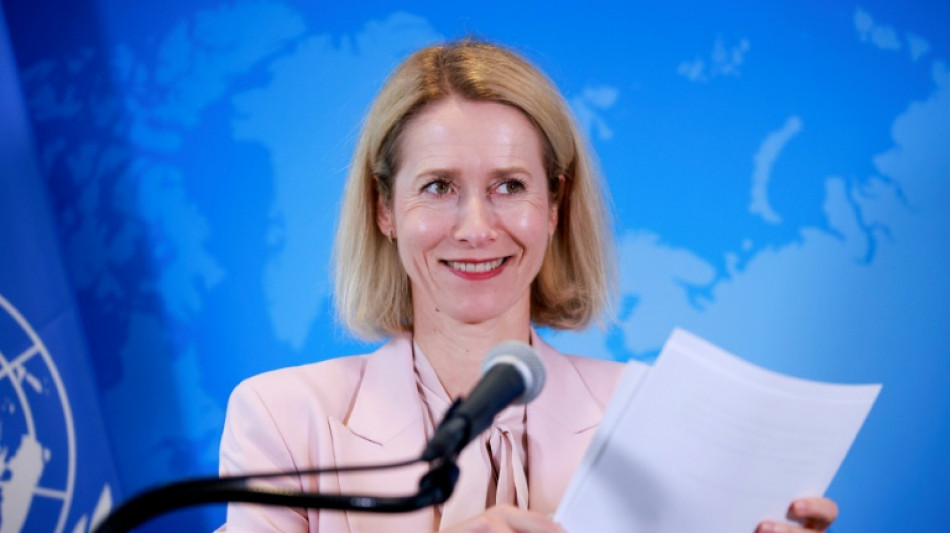
EU foreign policy chief calls for continued sanctions on Russia / Photo: Leonardo MUNOZ - AFP
EU top diplomat Kaja Kallas urged the bloc's member states Monday to maintain sanctions targeting Russia over the war on Ukraine, as countries work to push through an extension.
"Sanctions are a core pillar of our response to Russia's war" to deprive Moscow of funding, she told reporters in New York after a meeting of European Union foreign affairs ministers.
She added that officials aim to close talks on the rollover of Russia sanctions soon, and have the extension take place swiftly.
"We need to have this stability," with sanctions remaining in place for a longer time, Kallas added on the sidelines of the United Nations General Assembly.
Kallas stressed that the EU's position has not changed: "That's why we are also working on a new package of sanctions."
But discussions on the matter are ongoing as some member states sought to remove certain individuals from the bloc's blacklist.
EU countries failed Monday to finalise a deal that involved lifting sanctions on Russian oligarchs Alisher Usmanov and Mikhail Fridman.
Negotiations are set to continue in Brussels, in efforts to extend sanctions on almost 3,000 other individuals and entities over the war.
The 27-nation bloc has been scrambling to reach a deal on extending the sanctions regime ahead of a deadline late Tuesday.
France and Slovakia pushed for Russian-Uzbek billionaire Usmanov to be removed from the blacklist.
Luxembourg seized upon the demand by Paris to insist that if sanctions were lifted on Usmanov, then they should be lifted for Fridman as well.
Multiple diplomats earlier said that member states had reached a provisional agreement to take the pair off the EU's list as part of a compromise.
But the pact failed to get final approval, with a diplomat telling AFP that Latvia lodged a last-gasp objection.
Ukraine had reacted furiously to the prospect of the EU removing sanctions on the two prominent Russian businessmen.
More hawkish EU countries including Poland and Baltic states also fiercely opposed the easing of sanctions, arguing that pressure on Russia should be ramped up.
On Monday, Kallas said that Europe faces "a fast proliferation of sabotage attacks and airspace violations."
"Moscow is trying to scare Europe into winding down its support for Ukraine," she added. "As Russia is willing to take greater risks, we also need to impose greater costs."
"Russia's economy is one of its weakest parts," she said.
D.Chapman--MC-UK