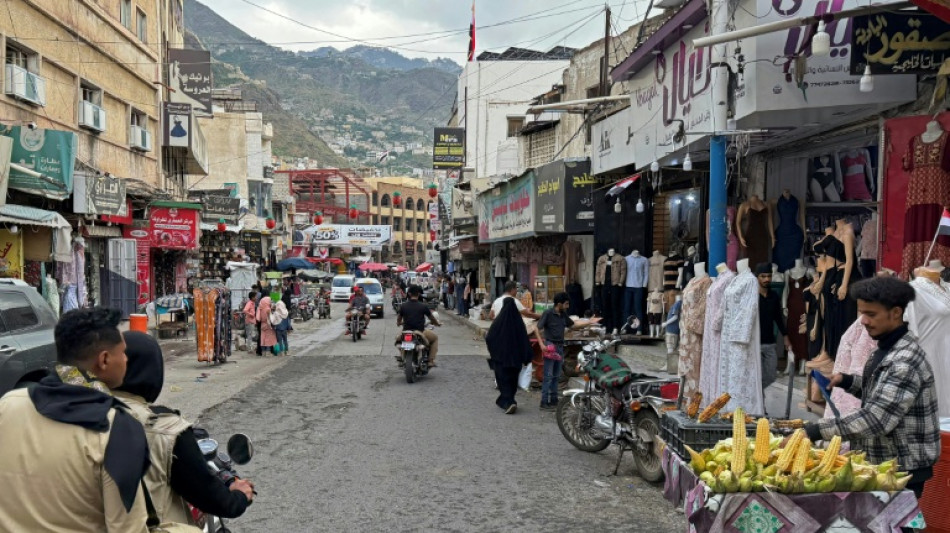
Yemen, Saudi Arabia target Houthis in new campaign as war escalates / Photo: - - AFP

Yemen's military backed by Saudi jets attacked Houthi targets on Monday as they launched an ambitious campaign to recapture all territory from the Iran-backed group after its lightning gains during the Middle East war.
The military said it carried out more than 1,000 strikes, while 100 warplanes attacked at dawn, according to the Saudi-led coalition that supports Yemen's government.
Yemen's government announced the lofty goal of retaking all Houthi territory -- much of it held for more than a decade -- on Sunday.
Last month the Houthis seized swathes of coastline along the Red Sea and Bab al-Mandab strait, a chokepoint for oil and cargo shipping.
As the offensive began, a source in the Saudi energy sector told AFP that an attack on Sunday had again halted pumping in the East-West pipeline to the Red Sea, a key conduit since Iran blockaded the Strait of Hormuz.
The long-running conflict in Yemen, one of the world's poorest countries and neighbour of Saudi Arabia, has flared anew months into the Middle East war that has sent crude prices soaring.
Saudi Aramco chief executive Amin Nasser warned on Monday that global oil stockpiles are "scarily thin" owing to the US-Iran war, days after G7 nations agreed to release more of their inventories to ease supply concerns.
"The system is already straining," Nasser told the Energy Intelligence Forum in London. "And with precious little else the world can turn to, the supply resilience cushion is scarily thin."
The Houthis have targeted Saudi oil infrastructure and tankers in the Red Sea since a ceasefire in Yemen's civil war unravelled in July.
The group has accused the Saudi-led coalition of carrying out hundreds of strikes.
- 'Stay and die' -
A day after the new offensive was declared, Yemen's military spokesman announced over 1,000 "strikes against artillery and rocket launcher positions, defensive fortifications, approach and reinforcement routes, supply lines and logistics assets, combat reinforcements".
Coalition spokesman Major General Turki al-Maliki said 100 jets flew at daybreak as part of "Operation 'Dawn of Yemen'". They provided "round-the-clock air support for the Yemeni armed forces on the ground", he wrote on X.
The strikes have yet to blunt ongoing Houthi advances on the ground.
On Sunday, the group effectively encircled the key city of Taiz after cutting the main supply route linking the city to the interim government capital of Aden.
However, Taiz residents remained defiant, vowing to stay and defend their city.
"We cannot leave the city. It is impossible for us to leave. We will stay and die inside this city," Fahmi Ahmed Ghaleb told AFP.
"Throughout the earlier clashes with the Houthis, we also stayed inside the city."
- Humanitarian crisis -
Taiz city remains under the control of government forces but has long been encircled from the north, east and west by Houthi fighters and remains one of the main fronts in Yemen's war.
The Houthis' surrounding of Taiz "is a significant development, but I think it is still too early to say that we are witnessing a decisive turning point", Ahmed Nagi, a senior analyst for Yemen at the International Crisis Group, told AFP.
While the war in Yemen predates the Middle East war that began with US-Israeli strikes on Iran, it has become the most active front in the wider conflict in recent weeks.
The Houthis launched a rapid offensive around the Red Sea coast in September that killed hundreds of combatants on both sides and, according to UN figures, displaced more than 145,000 people.
The Houthis took control of Yemen's capital, Sanaa, in September 2014, forcing out the internationally recognised government. They hold much of Yemen, including its most populous areas.
The Saudi-led international military coalition intervened in March 2015. The ensuing civil war caused hundreds of thousands of deaths and a spiralling humanitarian crisis that left a majority of the population relying on aid.
A.D.Eastaughffe--MC-UK