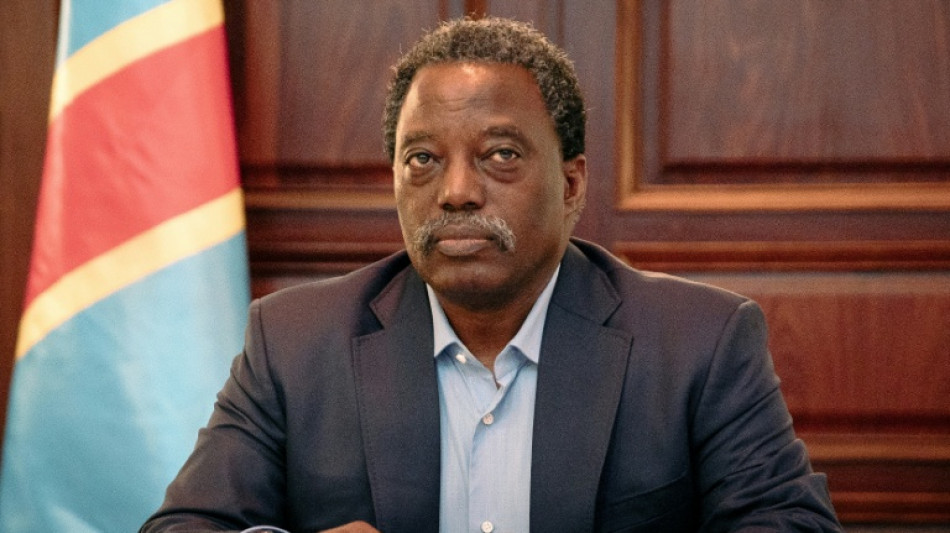
Former DR Congo president Kabila forms new force with M23 armed group / Photo: Jospin Mwisha - AFP
Former DR Congo president Joseph Kabila on Monday joined forces with the Rwanda-backed M23 armed group to head a new outfit, taking a more direct role in the insurgency ravaging the country's volatile east.
The tie-up was presented at a joint press conference at Kabila's residence in Goma, the major city in mineral-rich eastern Congo that the M23 has controlled since January 2025.
The new group -- known as the Front pour la Refondation de la Nation (FRN) -- was presented as a "politico-military" outfit that will "pool their strengths, resources and means" with the aim of "putting an end to tyranny by any means, including force."
It will be headed by Kabila and rebel leaders will serve as deputies.
Kabila was condemned to death in absentia a year ago for "complicity" with the M23.
The 55-year-old Kabila, who ruled from 2001 to 2019, is accused by Congolese authorities of being one of the initiators of the Congo River Alliance (AFC), the now dissolved political wing of the M23.
Kabila has denied the allegation.
The announcement of Kabila's new alliance comes amid an uncertain political climate in the Democratic Republic of Congo. President Felix Tshisekedi, 63, Kabila's successor, will reach the end of his second five-year term in 2028.
The Congolese constitution sets a limit of two five-year terms. Yet for several months, the presidential majority has been preparing public opinion on amending the text.
- Decades of conflict -
Kabila has been rarely seen in public since he stepped down after elections in 2018. He had steered the vast country since January 16, 2001 when his father Laurent Kabila, a former rebel leader-turned-head-of-state, was murdered by a bodyguard.
In 2006, Joseph Kabila was elected president in the country's first free elections since independence from Belgium.
In 2011, Kabila was re-elected in a vote marred by violence and fraud. A year later, the M23 -- a mainly ethnic Tutsi rebel group -- began an uprising in the eastern Kivu region.
The United Nations and Western governments accuse Rwanda of backing M23 but Kigali denies supporting the insurgency.
Eastern DRC has been plagued by violence for over 30 years with several attempts at mediation having failed so far.
A deal signed in December by Kinshasa and Kigali, under the auspices of Washington, has had no tangible effect on the ground.
Meanwhile, in July 2025, Kinshasa and the M23 committed, as part of a Qatari-mediated process, to a ceasefire that is not being respected.
N.Clarke--MC-UK