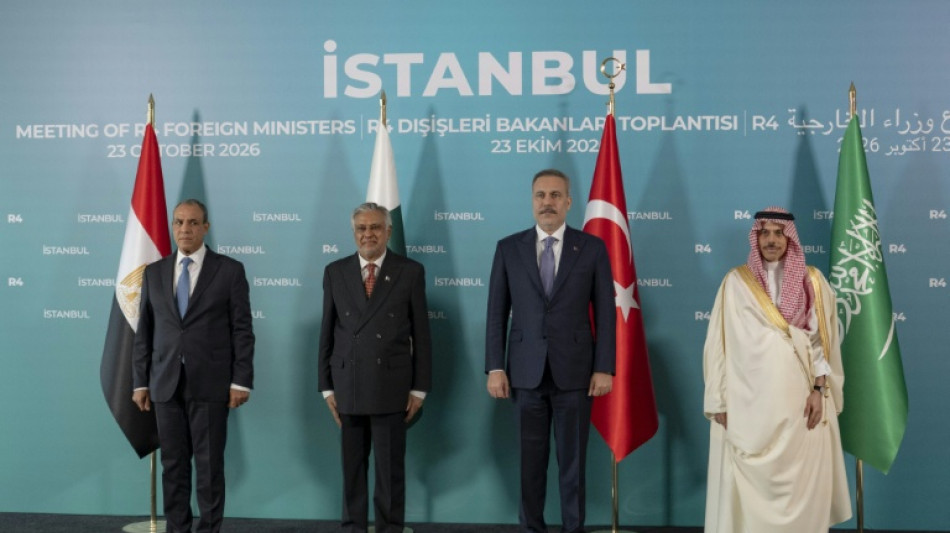
European, Mideast foreign ministers hold talks in Istanbul / Photo: Yasin AKGUL - AFP
Foreign ministers from eight European and Middle Eastern countries are set to meet in Istanbul on Friday in an unprecedented format for talks on the Strait of Hormuz and crises across the Middle East.
Ministers from Britain, France and Germany -- the so-called E3 -- as well as Italy will meet counterparts from the newly created R4 group comprising Turkey, Saudi Arabia, Pakistan and Egypt to discuss the Palestinians, developments in Yemen and Hormuz, and ways to end the Russia-Ukraine war, a Turkish foreign ministry source said.
The meeting of the R4 group has started at an Istanbul hotel overlooking the Bosphorus, the source added.
British foreign minister Ed Miliband's office said the Istanbul talks would essentially revolve around "the Strait of Hormuz and the situation in Saudi Arabia".
It said Miliband "will advocate for a diplomatic solution to the (Hormuz) crisis that restores full navigational rights and freedoms".
He will also stress "how Iranian tactics are being replicated across the region, with attacks on Saudi Arabia further destabilising the region and increasing pressure on vital waterways and global chokepoints, such as Bab al-Mandeb and the Suez Canal", it added.
France confirmed the talks on "the Iranian crisis in its various ramifications", hailing it as a first "in this format... against a backdrop of extreme instability and uncertainty in the region."
The meeting will aim to "strengthen coordination between Europeans and Middle Eastern countries in the face of crises that we did not choose and that affect us all," the French foreign ministry said.
Turkish Foreign Minister Hakan Fidan is hosting the meeting as Turkey steps up efforts to strengthen its regional role, including through the Mecca Defence Alliance, a defence pact launched with Pakistan and Saudi Arabia in August.
Turkey has said the pact is not aimed at any specific country and remains open to others, including Egypt.
Cairo has yet to decide whether to join the alliance. On Wednesday, President Abdel Fattah al-Sisi said Egypt would "defend Saudi territory" and would not take part in any attack on Yemen.
Intensifying attacks by Yemen's Iran-backed Houthis have forced Saudi Arabia to close its main airport and postpone a major investment conference, while a maritime blockade has threatened oil exports from the world's largest crude exporter.
Riyadh has since secured backing from its allies.
During a surprise visit on Wednesday, President Emmanuel Macron said French forces would help protect the Red Sea oil terminal of Yanbu.
Britain announced a day earlier that it would deploy fighter jets to help Saudi Arabia defend against the growing threat of Houthi attacks.
- 'Chance of success' -
Fidan praised regional cooperation Friday, saying, "Lasting solutions cannot be imposed from outside."
During the talks, Fidan is expected to stress that regional security requires countries in the region to "assume responsibility" and that Turkey prioritises cooperation mechanisms based on "regional ownership", according to Turkish officials.
He is also expected to say that "existing disputes should not be allowed to feed one another, conflicts should not be allowed to spread to new areas, and regional tensions should not be allowed to turn into broader instability".
Fidan is expected to call for increased international pressure on Israel over settlement expansion and what Ankara describes as "settler terrorism".
He will also reiterate Turkey's support for Saudi Arabia's security in the face of Houthi attacks and underline the need to safeguard freedom of navigation through the Strait of Hormuz and the Bab al-Mandeb.
The Black Sea is also expected to feature prominently, with Fidan highlighting Turkey's efforts to prevent the Russia-Ukraine war from spilling into the region.
burs-fo/jhb/rl
F.Enfield--MC-UK