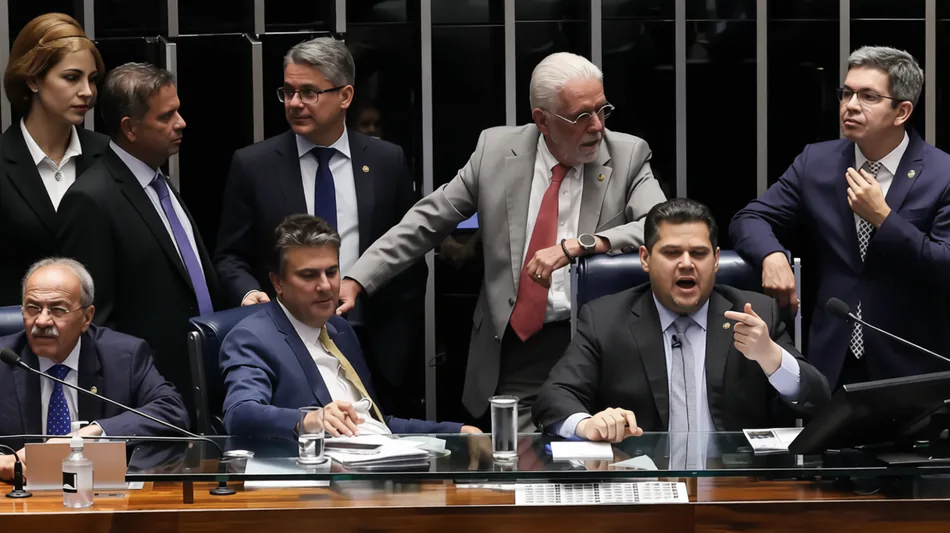
Brazilian Senate Approves Public Security Reform Without Lowering Criminal Age

The Brazilian Senate has unanimously approved a major constitutional amendment aimed at reorganizing public security forces and strengthening the fight against organized crime. The legislation establishes stricter prison regimes for faction leaders and creates new federal funding mechanisms, but explicitly excludes any reduction in the age of criminal responsibility from its provisions.
The Brazilian Senate approved a constitutional amendment on Tuesday evening that reorganizes the country's public security forces and expands the legal framework for combating organized crime. The proposal passed both voting rounds with unanimous support from senators present, securing 73 favorable votes in the first round and 75 in the second, surpassing the required threshold of 49 votes.
The amendment, initiated by the executive branch, introduces harsher penalties and more restrictive prison regimes for leaders of criminal factions and militias. It also establishes a new federal pact between the union, states, and municipalities to coordinate efforts against crime. President Luiz Inácio Lula da Silva has indicated that the creation of a Ministry of Public Security is contingent upon the approval of this measure.
The text-base of the proposal was previously approved by the Senate's Constitution and Justice Commission in early September and had already passed the Chamber of Deputies. With the Senate's final approval, the amendment will be promulgated by the National Congress.
Prior to the vote, senators debated several amendments that sought to lower the age of criminal responsibility from 18 to 16 years, or even 14 years in specific cases. The rapporteur of the amendment, Senator Rogério Carvalho (PT-SE), rejected these proposals in his final report but recommended they be processed as autonomous projects for separate future voting.
Carvalho argued that the matters addressed in the amendments were relevant but distinct from the central objective of the public security reform. "The materials treated in the amendments are relevant and deserve to be debated by this House," he stated. "They do not, however, confuse themselves with the central objective of PEC 18/2025, focused on combating organized crime and restructuring the federative governance of public security."
He noted significant doctrinal and political divergence regarding the lowering of the criminal majority. Some jurists argue that Article 228 of the Federal Constitution, which sets the age of criminal responsibility, constitutes a "petrous clause"—an unalterable part of the constitution protecting individual rights. Another school of thought holds that this article is not protected and can be modified by constitutional amendment.
Senator Rogério Marinho (PL-RN) had proposed Amendment 84 to lower the general age of criminal responsibility to 16, with a reduction to 14 for heinous crimes, torture, drug trafficking, terrorism, and participation in criminal organizations. Senator Camilo Santana (PT-CE) introduced Amendment 87, which would maintain the general age at 18 but reduce it to 16 for heinous crimes. These initiatives lack broad support within the government's base.
The reduction of the criminal majority remains a controversial topic among civil society organizations defending the rights of children and adolescents. Four other amendments addressing issues such as military access to National Public Security Fund resources and the inclusion of traffic agents in public security organs were also rejected by the rapporteur and did not proceed to a vote.
The approved amendment constitutionalizes the Unified Public Security System (SUSP), modifying Article 144 of the Constitution. It mandates that public security be exercised through federative cooperation and integrated, decentralized action among various institutions. The text defines that public security organs will articulate under this system to ensure the efficiency of prevention, prosecution, and penal execution.
Specific measures include imprisonment in maximum-security units for faction leaders, with restrictions or prohibitions on sentence progression. The proposal also introduces asset-based measures against crime proceeds, corporate liability for involved entities, and protections for whistleblowers and their families.
A notable addition is the possibility of creating civil municipal police forces, subject to external control by the Public Ministry, tasked with ostensive and community policing within their municipalities. The amendment also expands the attributions of the Federal Highway Police (PRF).
Financially, the proposal increases budgetary links for public security. Fifty percent of resources from the National Public Security Fund (FNSP) and the National Penitentiary Fund (Funpen) will be transferred by the union to states and municipalities, excluding operational and investment expenses of the national penitentiary police.
Additionally, 10% of the annual financial surplus of the Social Fund, linked to pre-salt activities, will be directed to security funds. The rapporteur wrote that these rules strengthen the funds, create budgetary blindages, and guarantee mandatory transfers, increasing financial predictability for police actions.
The proposal also establishes a Penal Policies System responsible for the Brazilian prison system and authorizes the union, states, and municipalities to act jointly in legislation regarding public security, police organization, municipal guards, and the socio-educational system.
R.Bailey--MC-UK