Sticker Shock Looms as Major Challenge in Push for Single-Payer Healthcare
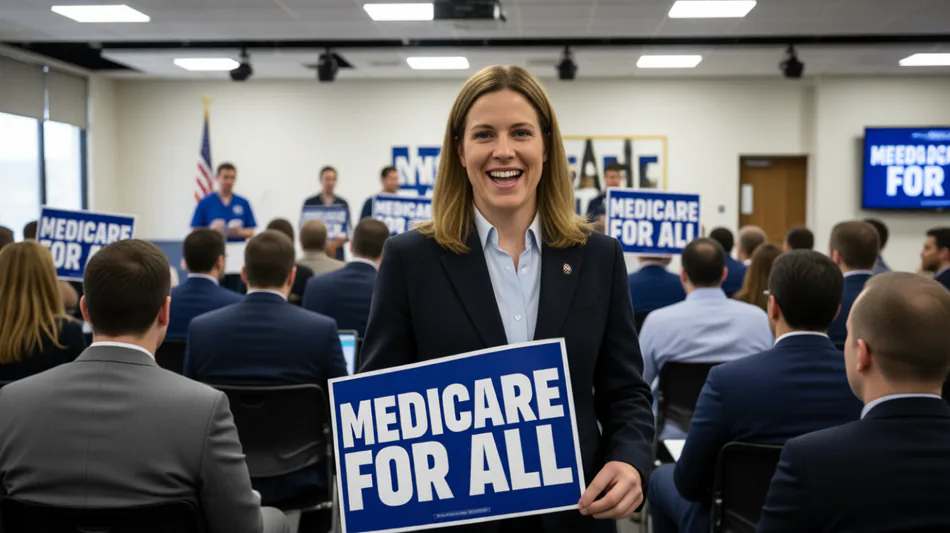
As an Oregon panel finalizes a statewide universal healthcare proposal and national Democrats renew their push for Medicare for All, the debate centers on staggering price tags. Proponents counter that Americans already spend over $5 trillion annually on healthcare, arguing that a single-payer system would consolidate these hidden costs rather than add new ones.
As an Oregon panel finalizes a statewide universal healthcare proposal and national Democrats renew their push for Medicare for All, the debate centers on staggering price tags. Proponents counter that Americans already spend over $5 trillion annually on healthcare, arguing that a single-payer system would consolidate these hidden costs rather than add new ones.
The tension between projected expenses and existing financial burdens defines the current landscape of healthcare reform efforts across the United States. In Oregon, the Universal Health Plan Governance Board released its report to the state legislature on November 23, outlining a plan to create a public corporation funded by corporate and personal taxes. The board estimates the plan will cost $69.7 billion annually starting in 2032, providing care to nearly everyone in the state with no premiums, copays, or deductibles.
Opposition has already coalesced around the financial implications of the proposal. Oregon Senate Republican Leader Bruce Starr criticized the plan in a news release, stating it would increase the entire state budget by 43% and impose "unfathomable" new taxes on residents. He described layering double-digit payroll and income taxes as "irresponsible and fiscally unsound," arguing that handing control of hospitals, doctors, and insurance to a single bureaucracy is a failure of basic responsibilities.
However, board members and supporters argue that the current system is already far more expensive for most Americans. An analysis commissioned by the state from the Milliman consulting firm found that without changes, total healthcare spending in Oregon would reach at least $76.3 billion annually by 2032. The board’s estimate of $69.7 billion suggests a potential saving compared to the status quo, achieved by reducing administrative costs, negotiating drug prices, and combating fraud.
Mike Leahy, a former health plan executive serving on the Oregon board, expressed frustration with critics who dismiss the plan as unaffordable without examining the underlying data. "I just don’t want people to — because I’ve seen they’ve already started to — make all kinds of assertions about our work and saying, ‘It’s unaffordable, we can’t do it, end of story,’” Leahy said during an October meeting. “I’d like us to give this plan a chance of happening.”
The board maintains that up to three out of every five people would pay less under the single-payer system when comparing new taxes to current premiums and out-of-pocket costs. The Oregon design is modeled after Taiwan’s national health system, which relies on nearly equal shares of contributions from households, companies, and the government. Supporters frequently point to Taiwan as a high-performing system with public satisfaction rates topping 90%.
Similar arguments are being made at the federal level regarding "Medicare for All," a policy that has gained renewed momentum following Democratic victories in the recent midterm elections. A recent White House cost estimate pegs the annual price tag of extending Medicare benefits to all Americans at $4.7 trillion, with the Council of Economic Advisers estimating a total federal cost of $47 trillion over 10 years.
Conservative critics have decried these figures as a massive increase in federal spending. Joel Zinberg of the Paragon Health Institute wrote an op-ed for The Wall Street Journal criticizing the White House estimate. However, proponents argue that these numbers ignore the existing financial reality of the U.S. healthcare system.
Government data shows that total healthcare spending from all sources in the United States reached approximately $5.3 trillion in 2024. This spending is on pace to top $72 trillion combined over the 10-year period from 2025 through 2034. While this estimate includes spending for the military, veterans, and the Indian Health Service, as well as elective services that might not be covered under a universal plan, supporters argue the price tag for national coverage could still appear favorable compared to current expenditures.
"People are aware that healthcare is very expensive and that they have trouble getting access to it even if they have decent insurance," said Stephanie Woolhandler, a public health professor at the City University of New York’s Hunter College. "But if they think $47 trillion is a big number relative to what we’re spending now, they’re mistaken."
Cynthia Cox, senior vice president at KFF, a health information nonprofit, emphasized that the current system already involves trillions of dollars spent by the federal government, states, individuals, private insurers, and other third-party payers. "We already do spend trillions of dollars on healthcare," Cox said. "It’s just that it’s not only spent by the federal government but also by states, individuals, private insurers, and other third-party payers."
The challenge for proponents lies in communicating this nuance to the public. John McDonough, a health policy professor at the Harvard T.H. Chan School of Public Health, noted that most people confuse their direct out-of-pocket payments with the total cost of care. "Most people think that what they pay out-of-pocket or out of their paycheck directly is what it costs, and they’re not as familiar with the larger piece," McDonough said. "Nobody on Medicare knows what that costs. Nobody on Medicaid knows what that costs. Very few people on the exchanges know. So, with something brand-new, it’s a massive education effort just to get to the starting line."
Deborah Richter, a family physician and board president for Vermont Health Care for All, explained that universal healthcare proposals bring all hidden spending together into a single number, which can be shocking to consumers. "People get the impression that this is on top of what they’re already paying," Richter said. "And they’re already saying: ‘Oh, my God. I’m paying this. I can’t pay this extra tax.’"
Richter argued that Americans are already paying the entire bill through a mix of taxes, Medicare and Medicaid contributions, out-of-pocket costs, increased prices, and lower wages. "What people fail to realize is that we’re already paying the entire bill," she said. "So you’re either paying in taxes, Medicare, Medicaid taxes, or you’re paying out-of-pocket for copays and deductibles, or coinsurance. You’re paying increased prices and getting lower wages."
The political landscape for single-payer healthcare has shifted with the change in congressional control. Sen. Bernie Sanders, a Vermont independent who caucuses with Democrats and is the best-known advocate for Medicare for All, is expected to be elevated to chairman of the Senate Health, Education, Labor, and Pensions Committee. Additionally, the Democratic wave ushered in proponents such as Sen.-elect Abdul El-Sayed of Michigan, who campaigned on a universal healthcare platform.
This shift is likely to push the debate over single-payer healthcare and its costs or savings to the forefront in the next two years, leading into the 2028 presidential election. Democratic leaders in Washington have indicated plans for a major push on healthcare affordability in the upcoming Congress.
However, previous efforts to implement universal healthcare have struggled. In 2014, then-Vermont Governor Peter Shumlin pulled the plug on the state’s single-payer push after difficulties implementing the healthcare exchange under the Affordable Care Act sapped his political capital. Single-payer ballot measures in California, Massachusetts, and Oregon also struggled to garner even a quarter of the voting public’s support.
President Donald Trump is seen as unsupportive, if not outright hostile, to the notion of a government-financed, single-payer health system. Backers of universal healthcare say the next two years will be crucial for debating how such a system could be designed and financed, and how it could be sold to voters while waiting for a potentially more cooperative federal administration.
In Oregon, the legislature could vote on the plan as early as next year or refer the proposal to voters as a ballot measure in 2028. The outcome of these efforts will depend largely on whether backers can alleviate fears of massive new taxes and government spending by effectively communicating the financial realities of the current system.
E.Fisher--MC-UK