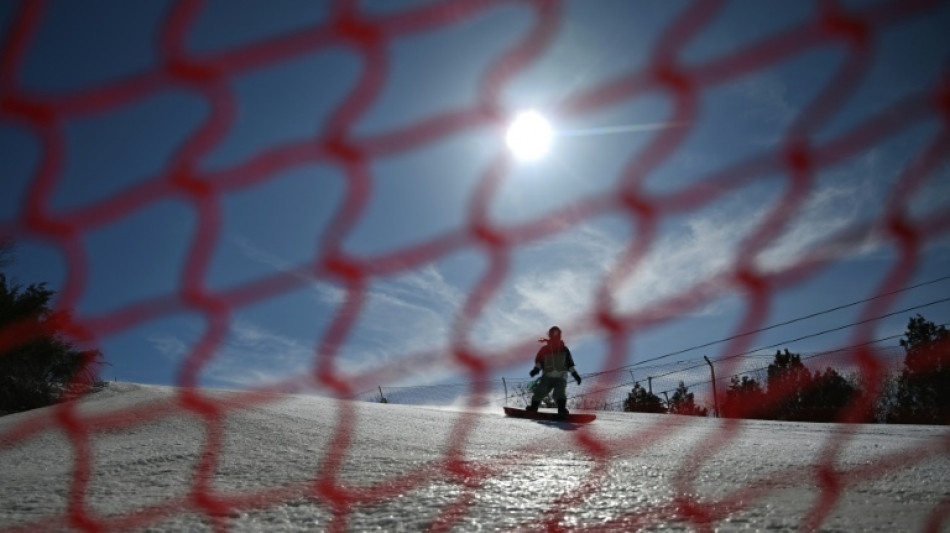
Chinese firms seek to loosen West's grip on lucrative snow business / Photo: Pedro PARDO - AFP

Lianhuashan's slopes have been kept snow-covered by ageing European snow cannons for more than 20 years, but the Beijing resort added its first Chinese snowmaker this ski season.
The snow gun, made by Beijing-based Carving Ski, costs about a third less than Western brands such as Italian giant TechnoAlpin, Carving resort manager Tang Lingling told AFP on a crisp February morning at the bottom of the slopes.
"By producing and assembling locally, we avoid the high costs of overseas production and shipping," said Tang, whose company sold around 200 snow machines last year.
"But the pressure from competition is very great."
"The truth is, the profit margin for our snow machine business isn't high."
However, Chinese winter sports firms are slowly chipping away at foreign dominance in the 84.6 billion yuan ($12.3 billion) snow equipment market despite such ferocious price competition.
They aim to replace foreign brands at home before conquering overseas markets by investing in research and making use of China's formidable supply chains.
- Targeting the masses -
China's snow-related equipment sales have surged almost fourfold since 2015, but interest has levelled off since the Beijing Winter Olympic Games in 2022 and a post-Covid boom.
Chinese consumers are now tightening their belts.
"Since 2007, the price of raw materials has at least doubled... but we haven't raised our prices," said Jin Huiyuan, founder of snowboard brand Lidakis.
Her company targets beginners and children with social media-friendly, ultralight boards with detachable dolls that she sells for around 2,000 yuan ($290) each.
They sold around 20,000 boards last year out of their frigid warehouse in Zhangjiakou, close to the slopes used for the 2022 Winter Games.
"Big foreign brands are high-end brands, which are bought by the rich; ours is for the masses. So, on this point, I think we are competitive with them, since not every consumer has lots of money," Jin said.
- Olympic void -
The government has heavily supported this "ice and snow economy", with President Xi Jinping's goal of 300 million winter sports participants surpassed by 2022.
Companies such as Carving and Lidakis benefit from research funding and subsidised rents.
Still, foreign brands dominate the high-end market.
Domestic skis and boards "haven't reached the level" of international competitors, according to Li Zhibo, general manager of ski firm Qianmao Xuelong.
"Some are century-old companies; we can't overtake that kind of history and technical accumulation overnight."
Qianmao mostly sells entry-level ski boots and bindings, but has pivoted to high-end equipment and supplied skis to China's Aerials team for the Milan-Cortina Winter Olympics in February.
However, eventual women's Aerials champion Xu Mengtao opted for the Swiss brand Oxess during the competition.
Likewise, superstars Su Yiming and Eileen Gu secured gold using boards from US brand Burton and skis by Switzerland's Faction, highlighting the gap between Chinese brands and foreign competitors.
- Snow blow -
Despite not finding wide global popularity, some Chinese brands are finding a niche for themselves.
Lidakis has sold to Kazakhstan, South Korea and Iran, while Carving has exported to Russia, filling the void left by European firms locked out by EU export restrictions imposed after the invasion of Ukraine.
For now, the focus is on a domestic shift.
Tang Lingling is optimistic about the transition from imports to local manufacturing.
"In many ski resorts, you will see a lot of European snow machines at first. Gradually, (resorts) are beginning to choose to try Chinese snow-making machines," she said.
"Later, they won't even consider imported ones. They will directly choose Chinese brands."
E.Fisher--MC-UK