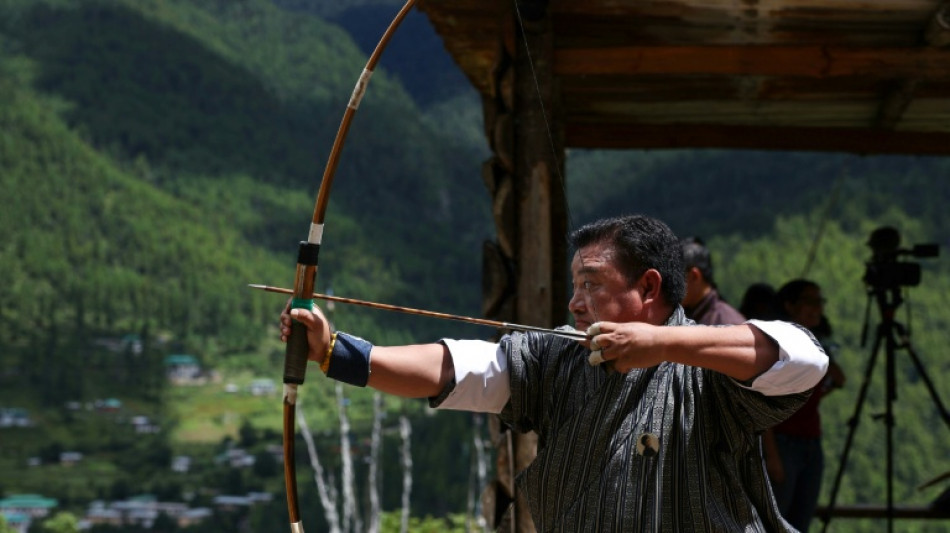
Bhutan's traditional archers lose ground to development / Photo: Niharika KULKARNI - AFP

Atop a steep hillside near Bhutan's capital Thimphu, an arrow slices through the air and slams into a wooden target with a thud, prompting a round of celebratory song.
Traditional archery is Bhutan's national sport and has a storied history, but some fans fear for its future as development and safety concerns eat away at space for archery ranges.
Played with a bamboo bow and arrows, the sport evolved from hunting and military traditions and is now a key part of cultural events, as well as a popular weekend activity.
But it is a sport that requires space and flat terrain, which are in growing demand, particularly in the capital.
"Since now our development is coming up, archery grounds are occupied by residences, so it's very difficult to get a play ground," lamented archer Sonam Dorji, who works at a conservation group, as he competed in an all-day tournament.
Bhutanese archery is played in teams that vary in size depending on whether the game is friendly or competitive.
Each team sets up at one end of the range and aims at small wooden targets up to 145 metres away.
Players wear the country's traditional striped "gho" belted knee-length robe, complete with knee-high socks, though footwear is of the modern variety, ranging from trainers to hiking boots.
Archers get two arrows per go, and the first team to get 25 wins. A hit anywhere on the target earns points, along with an obligatory celebratory song and shuffling dance.
Play is relatively raucous -- often enhanced by consumption of beer or the local tipple ara -- with taunts and shouts of encouragement part of the fun.
Teammates often stand either side of the target and shout guidance or wave to try to guide incoming arrows, jumping aside at the last minute to avoid injury.
The sport has been struggling for years to compete with the growing popularity of alternatives like football, said Sangay Phuntsho, who had travelled several hours from Wangdue Phodrang to Bhutan's second city Paro for an all-day competition.
"Times change," he told AFP in between shots at the target.
"We have a lot of other options now with sports... young people normally they prefer to play advanced games like football."
- 'Stronger safety measures' -
The country's archery association said the declining number of ranges was also due to safety concerns over the rising use of more powerful compound bows.
"Development and increasing pressure on land are contributing factors, but safety has also become a major concern," said Pema Tenzin, general secretary of the Bhutan Archery Federation.
"Given the power and speed of compound bows, their use in long-range grounds, particularly in densely populated areas, requires much stronger safety measures."
The federation and Bhutan's Indigenous Games and Sports Association are working with the country's Olympic committee to find land to establish more ranges "in a safer and more organised setting," he added.
Jamyangla, who like many Bhutanese uses a single name, said he encouraged his son to take up the sport, but the lack of ranges made it hard for him to learn.
"He doesn't have enough grounds to test his ability," the 48-year-old power company employee said, calling for government support to set up national-level tournaments and additional ranges.
He rejected safety concerns about the sport, though injuries are reported each year, including a man who survived an arrow to the heart earlier this year.
Officials and some opponents of the sport warn that the tradition of drinking while playing makes an already risky sport all the more dangerous.
But players like Sonam consider it part of the fabric of Bhutanese life.
"We are getting more social cooperation and getting to know each other and know more about our people," he said.
"It is our national game which has come down from our forefathers... we have to preserve (it)."
A.D.Eastaughffe--MC-UK