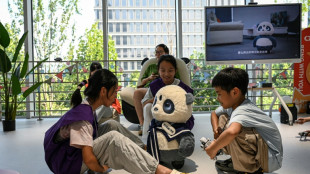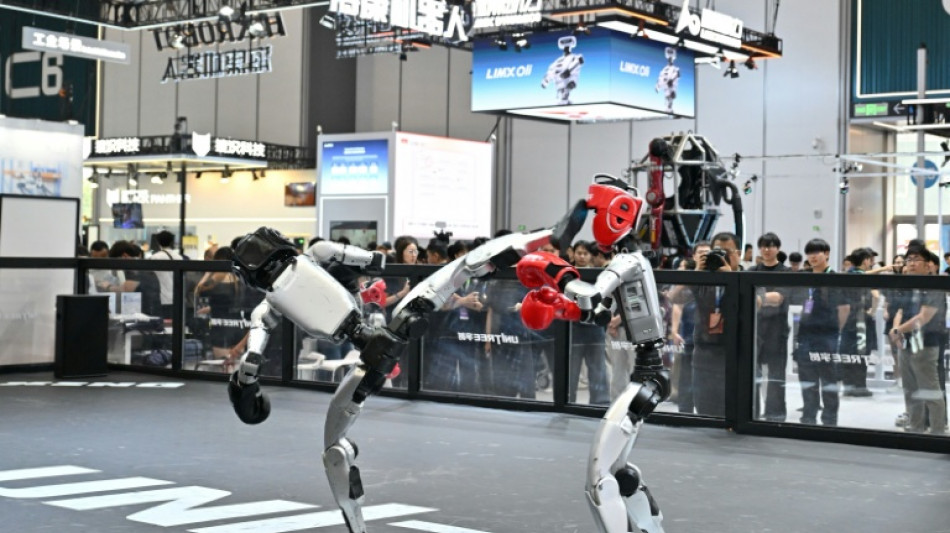
Robots sort packages and serve fast food at Beijing showcase / Photo: ADEK BERRY - AFP

Robots sorting parcels and serving fried chicken enthralled visitors at a robotics expo in Beijing on Wednesday, where hundreds of companies set out their pitches for a future labour market transformed by artificial intelligence.
The Chinese government has embraced robotics as a strategic industry, and local firms have ploughed resources into the development of embodied AI.
The results of that investment were very much in evidence on the first day of the World Robot Conference, as thousands of Chinese and foreign visitors weaved through demonstrations of robots in houses, shops and factories.
"Our greatest focus is on when robots will make their way into thousands of industries and thousands of homes," said Kang Yu, a Beijing-based investor attending the expo for a third straight year. "This requires them to possess a certain level of intelligence."
At one booth, visitors pointed their phones at a humanoid wearing an apron as it gingerly reached for a toy chicken drumstick before clamping down and lifting the fake meat into a bucket.
Nearby, dozens of guests craned their necks at a towering humanoid as the limbs on the five-metre (16-feet) model slowly manoeuvred up and down.
"Is it a 'machine', or a 'human'?" posited a sign next to the enormous machine. "That is a distinction for the future."
Hundreds of robotics startups, some just a couple years old, peppered the sprawling convention centre hoping to dazzle.
"You can see the improvements every year," said Soumodip Sarkar, the executive president of a science park in Portugal who was visiting the expo on a tour of factories in China.
"This is a space I see that China is already dominating and is going to dominate."
- Challenges ahead -
Particularly impressive were improvements in robotic hands, Sarkar said, wiggling his fingers.
For instance, robots that last year could not pick up fruit now do so -- an important breakthrough as "we have a big need for agricultural applications", he said.
While Chinese visitors made up an overwhelming majority of the attendees, there were more people from abroad than before, said investor Kang.
Her company was one of the first to invest in Chinese robotics darling Unitree, whose share price soared over 600 percent on its debut in Shanghai on Wednesday.
At the Unitree booth, a robot made a sandwich with two slices of bread and a single piece of lettuce, pinching the leaf to assemble it.
Kang said the applications of embodied AI have become more obvious, pointing to robots making noodles or acting as emotional companions.
But the industry is still "full of challenges", Kang said.
For example, "when there's poor internet connection, response time will be very slow".
Nearby, a table-tennis-playing humanoid the height of a 10-year-old child was wired to the internet as it returned a ball to its human opponent.
Elsewhere, a staff member lunged towards a toddler-sized robot in a T-shirt that threatened to knock into a human child.
- 'ChatGPT moment'
There are geopolitical obstacles too.
Washington has blacklisted Unitree and dozens of other Chinese tech firms it says are aiding the military.
Some fears of illicit data transfers also exist in Europe, said Sarkar, the visitor from Portugal.
But change is in the air, said Yang Qian, the COO of X Square Robot, which produces robots for use in homes and logistics.
Many foreign customers, including from the United States, "often come to our company for research", she told AFP as robotic arms pushed packages along a conveyor belt in the booth behind her.
"So I think everyone's view of China's overall technological ecology is changing."
However, Yu Chao, founder and CEO of Lumos Robotics, said the humanoid industry has not yet had its "ChatGPT moment".
"When ChatGPT came out, people were shocked. It's very disruptive, very revolutionary," he said.
"I think in about three years, we can get there."
A.Smith--MC-UK